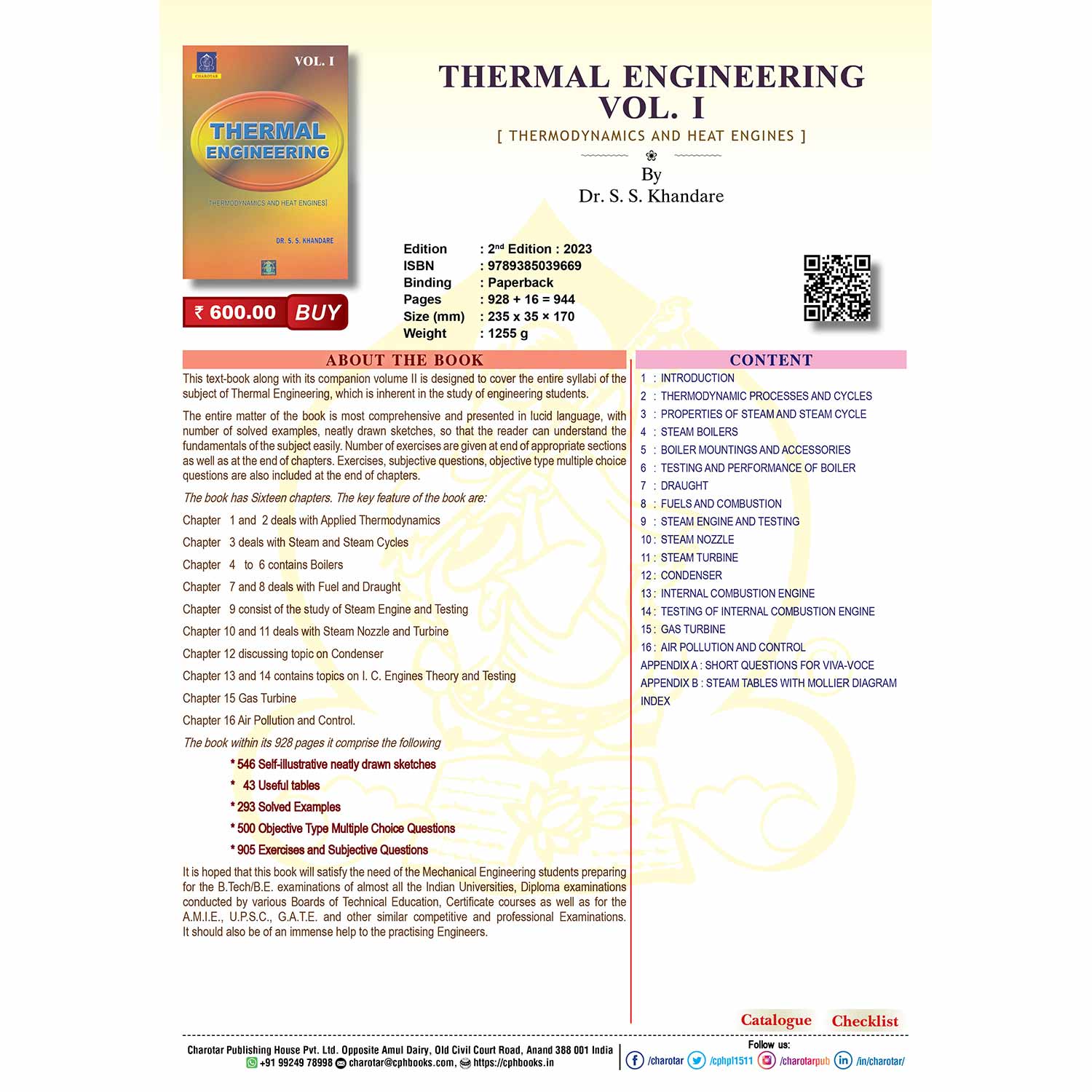
Content
1 : INTRODUCTION
2 : THERMODYNAMIC Processes AND CYCLES
3 : PROPERTIES OF STEAM AND STEAM CYCLE
4 : STEAM BOILERS
5 : BOILER MOUNTINGS AND ACCESSORIES
6 : TESTING AND PERFORMANCE OF BOILER
7 : DRAUGHT
8 : FUELS AND COMBUSTION
9 : STEAM ENGINE AND TESTING
10 : STEAM NOZZLE
11 : STEAM TURBINE
12 : CONDENSER
13 : INTERNAL COMBUSTION ENGINE
14 : TESTING OF INTERNAL COMBUSTION ENGINE
15 : GAS TURBINE
16 : AIR POLLUTION AND CONTROL
Appendix A : SHORT QUESTIONS FOR VIVA-VOCE
Appendix B : STEAM TABLES with mollier diagram
index
Detailed Content
[vc_row][vc_column][vc_tta_tabs][vc_tta_section title=”Page 1″ tab_id=”1583906791406-8292f532-8670″][vc_column_text]
Chapter 1 INTRODUCTION
1-1. Thermal engineering
1-2. Areas of thermal engineering
1-2-1. Heat engines
1-2-2. Energy sources
1-2-3. Refrigeration and air-conditioning
1-2-4. Heat and mass transfer
1-2-5. Fuel and combustion system
1-2-6. Compressor and blowers
1-2-7. Cryogenics
1-2-8. Jet Propulsion
1-3. Engineering thermodynamics
1-4. Working fluids and thermodynamic system
1-5. Thermodynamic state and thermodynamic process
1-6. System of units
1-7. Units of length, area and volume
1-8. Specific volume
1-9. Units of mass
1-10. Units of force
1-11. Units of work and power
1-12. Units of energy
1-13. Measurements of properties of fluid
1-13-1. Pressure
1-13-2. Temperature
1-14. Zeroth law of thermodynamics
1-15. Temperature measurement
1-16. Pyrometers
1-16-1. Thermo-electric pyrometer
1-16-2. Radiation pyrometer
1-16-3. Optical pyrometer
1-16-4. Pyrometric cone or Seger cone pyrometer
1-17. Absolute temperature scale and absolute zero
1-18. NTP (normal temperature pressure) and STP (standard
temperature pressure) conditions
1-19. Volume
1-20. Work
1-21. Heat
1-22. Properties of substances
Objective questions
Chapter 2 THERMODYNAMIC PROCESSES AND CYCLES
2-1. Perfect gas
2-2. Vapour
2-3. Boyle’s law
2-4. Charles’ law
2-5. Combination of laws of Boyle and Charles
2-6. Vander-Waal’s equation
2-7. Units of R
2-8. Universal gas constant
2-9. Avogadro’s law
2-10. Enthalpy
2-11. Entropy
2-12. Intensive and extensive properties
2-13. Thermodynamic system
2-14. Law of conservation of energy
2-15. First law of thermodynamics
2-16. Concepts of the second law of thermodynamics
2-16-1. Kelvin-Plank statement
2-16-2. Clausius statement
2-17. Specific heats of a gas
2-18. Ratio of specific heats
2-19. Relation between the two specific heats of a gas and the
specific gas constant
2-20. Expansion and compression of gases
2-21. Point and path functions
2-22. Process
2-23. Constant volume process
2-24. Constant pressure process
2-25. Isothermal process
2-26. Isentropic process
2-27. Polytropic process
2-28. Determination of the index of expansion or compression
2-29. Comparison of work done by a gas during expansion for
various processes
2-30. Mean effective pressure
2-31. Summary of equations for gas processes
2-32. Other important processes
2-32-1. Hyperbolic expansion
2-32-2. Free expansion
2-32-3. Throttling process
2-33. Gas tables
2-34. Approximation for heat absorbed
2-35. Typical examples
2-36. Reversibility
2-37. Air standard cydes
2-38. Heat machine
2-39. Useful work
2-40. Efficiency of cycle
2-41. Air standard efficiency of cycle
2-42. Assumptions in thermodynamic cycles
2-43. Thermodynamic cycles
2-44. Carnot cycle
2-45. Otto cycle
2-46. Mean effective pressure
2-47. Diesel cycle
2-48. Dual combustion cycle
2-49. Stirling cycle
2-50. Ericsson cycle
2-51. Brayton cycle
2-52. Comparison of ideal cycles
2-53. Reversed Brayton cycle (Bell-Coleman cycle)
2-54. Coefficient of performance (COP) flow processes
Flow processes
2-55. Flow processes
2-56. Steady flow energy equation
2-57. Control volume and flow work
2-58. Flow work of steady flow system
2-59. Applications of steady-flow energy equation
Objective questions
Chapter 3 PROPERTIES OF STEAM AND STEAM CYCLE
PROPERTIES OF STEAM
3-1. Vapour and steam
3-2. Conservation of form
3-3. Phase diagram
3-4. Effect of pressure on the boiling point of water
3-5. Temperature-pressure curve for steam
3-6. Generation of one kg of steam at a given pressure from water
initially at 0°C
3-7. Conditions of steam
3-8. Saturated steam
3-9. Dry saturated steam and wet steam
3-10. Superheated steam
3-11. Supersaturated steam
3-12. Properties of steam
3-13. Dryness fraction of saturated steam
3-14. Use of steam tables
3-15. Sensible heat
3-16. Latent heat of vaporization
3-17. Enthalpy of wet steam
3-18. Enthalpy of superheated steam
3-19. Specific volume of steam
3-20. Internal energy of steam
3-21. Entropy of vapours
[/vc_column_text][/vc_tta_section][vc_tta_section title=”Page 2″ tab_id=”1583906791425-c8429514-c6c0″][vc_column_text]
3-22. Temperature–entropy diagram
3-23. Heat entropy chart (Mollier chart)
3-24. Pressure-Enthalpy chart
3-25. Heating and expansion of vapours
3-26. Methods of determination of dryness fraction of steam
3-27. Bucket calorimeter
3-28. Separating calorimeter
3-29. Throttling calorimeter
3-30. Combined separating and throttling calorimeter
3-31. Typical Examples
Steam cycle
3-32. Steam cycle
3-33. Carnot cycle
3-34. Rankine cycle
3-35. Comparison of Rankine and Carnot cycles on temperature
entropy diagram
3-36. Work done during Rankine cycle on pressure-volume diagram
3-37. Modified Rankine cycle
Objective questions
Chapter 4 STEAM BOILERS
4-1. Functions of boiler
4-2. Classification of boilers
4-3. Terms commonly employed in connection with boilers
4-4. Lancashire boiler
Construction of Lancashire boilers
4-5. Cornish boiler
4-6. Multi-tubular fire tube boilers
4-7. Horizontal return tubular boilers
4-8. Locomotive boiler
4-9. Vertical boilers
4-10. Cochran boiler
Construction of Cochran boiler
4-11. Scotch Marine fire-tube boiler
Construction of Scotch Marine fire-tube boiler
4-12. Water tube boilers
4-13. Babcock and Wilcox water tube boiler
4-13-1. Construction of Babcock and Wilcox type boiler
4-13-2. Settings for the Babcock and Wilcox boiler
4-14. Stirling boiler (Bent tube type water tube boiler)
4-15. Integral furnace boiler
4-16. Waste heat boilers
4-17. Super critical boilers
4-18. Boiler specifications
4-19. Fluidized bed combustions boilers (FBC)
4-19-1. Pulverized coal firing system
4-19-2. Pulverized fuel
4-19-3. Advantages of pulverized fuels
4-19-4. Disadvantages of stroker firing system
4-19-5. Fluidized bed combustion
4-19-6. Advantages of FBC boilers
4-19-7. Classification of fluidized bed combustion (FBC) boilers
4-20. Thermal efficiency of FBC boiler
4-20-1. Unburnt fuel in flue gases
4-20-2. Sensible heat in flue gases
4-20-3. Surface radiation losses
4-21. Pulverized fuel handling systems
4-21-1. Unit system
4-21-2. Central or bin system
4-22. Pulverized fuel burners
4-22-1. Long flame or U-flame or streamlined burners
4-22-2. Short tlame or turbulent burner
4-22-3. Tangential burners
4-23. Modern boilers
4-23-1. La Mont boiler
4-23-2. Benson boiler
4-23-3. Loeffler boiler
4-23-4. Schmidt-Hartmann boiler
4-23-5. Velox boiler
4-24. Advantages of high pressure boilers
Objective questions
Chapter 5 BOILER MOUNTINGS AND ACCESSORIES
5-1. Boiler mountings
5-2. Safety valves
5-2-1. Dead weight safety valve
5-2-2. Spring loaded safety valve
5-2-3. Lever loaded safety valve
5-2-4. High steam and low water safety valve
5-3. Water level indicators
5-4. Pressure gauge
5-5. Attachment for inspector’s test gauge
5-6. Steam stop valve
5-7. Feed check valve
5-8. Blow-off cock
5-9. Manhole
5-10. Fusible plug
5-11. Boiler accessories
5-12. Economizers
5-13. Air pre-heaters
5-14. Superheaters
5-14-1. Methods of superheating steam
5-14-2. Methods of control of superheat
5-14-3. Smooth tube hairpin type superheater
5-14-4. Multiple loop superheaters
5-15. Feed pumps
5-15-1. Duplex feed pump
5-16. Steam drier or separator
5-17. Steam trap
5-17-1. Expansion trap
5-17-2. Bucket or float steam trap
5-18. Injectors
5-19. Pressure reducing valve
Objective questions
Chapter 6 TESTING AND PERFORMANCE OF BOILER
6-1. Feed water
6-2. Steam
6-3. Fuel
6-4. Duration of boiler test
6-5. Flue gas sampling
6-6. Flue gas temperature measurement
6-7. Air
6-8. Draught
6-9. External heat losses from boiler and brick work
6-10. Auxiliary Plant
6-11. Air Infiltration and by-passing
6-12. Performance test
6-13. Thermal efficiency of boiler
6-14. Evaporation
6-15. Evaporation ratio
6-16. Boiler performance
6-17. Equivalent evaporation
6-18. Reference standards
6-19. Direct method of testing
6-20. Indirect method of testing
6-21. Measurements required for direct method of testing
6-22. Boiler efficiency
6-23. Indirect method of testing
6-24. Measurement of parameters
6-25. Calculation of boiler efficiency by indirect method
6-26. Heat losses in boiler
6-27. Boiler heat balance
6-28. Boiler trial
[/vc_column_text][/vc_tta_section][vc_tta_section title=”Page 3″ tab_id=”1583906793965-9c4feab0-c255″][vc_column_text]
6-28-1. Objective of a boiler trial
6-28-2. Plant
6-28-3. Report sheet on boiler trial
6-28-4. Specimen set of calculations
6-28-5. Graphical representation of results
6-28-6. Conclusions and criticisms
6-29. Boiler house instruments
6-30. Boiler house records
Economic analysis
6-31. Typical examples
Objective questions
Chapter 7 DRAUGHT
7-1. Definition of draught
7-2. Classification of draught
7-3. Functions of a chimney
7-4. Natural draught
7-5. Determination of a height of a chimney to produce a given
total static draught
7-6. Condition for maximum discharge through a chimney
7-7. Efficiency of a chimney
7-8. Draught losses
7-9. Artificial draught
7-10. Mechanical draught
7-11. Induced draught
7-12. Forced draught
7-13. Balanced draught
7-14. Power required to drive a fan
7-14-1. Power required for forced draught fan
7-14-2. Power required for an induced draught fan
7-15. Steam jet draught
7-16. Draught gauges
Objective questions
Chapter 8 FUELS AND COMBUSTION
FUELS
8-1. Classification of fuels
8-2. Solid fuels
8-3. Liquid fuels
8-4. Hydrocarbons
8-5. Gaseous fuels
8-6. Calorific value of fuels
8-7. Theoretical determination of calorific value of fuel
8-8. Calorific value of gaseous fuels
8-9. Experimental determination of calorific value of a fuel
8-10. Bomb calorimeter
8-11. Calorific value of liquid fuels
8-12. Calorific value of gaseous fuels
8-13. Gas calorimeters
8-13-1. Boy’s gas calorimeter
8-13-2. Junker’s gas calorimeter
8-14. Alternative fuels
COMBUSTION
8-15. Combustion of a fuel
8-15-1. Combustion of carbon
8-15-2. Combustion of carbon monoxide
8-15-3. Combustion of hydrogen
8-15-4. Combustion of sulphur
8-16. Stoichiometric air–fuel ratio
8-17. Excess air
8-18. Determination of the flue gas analysis by mass and by volume
8-19. Determination of air supplied from volumetric analysis of
flue gases
8-20. Determination of air leakage in boiler flues
8-21. Determination of the quantity of air supplied per kg of fuel
from the analysis of flue gases when given by mass
8-22. Chemically correct air fuel ratio
8-22-1. Combustion of hydrogen
8-22-2. Combustion of carbon monoxide
8-22-3. Combustion of marsh gas
8-22-4. Excess air coefficient
8-23. Determination of flue gas analysis by volume and by mass
in case of gaseous fuel
8-24. Determination of quantity of air supplied per m3
of gas from
dry flue gas analysis in case of gaseous fuels
8-25. Calculation of heat losses
8-26. Exhaust gas analysis
8-26-1. Conventional method
8-26-2. Modern methods
8-27. Determination of air-fuel ratio with the help of dry flue gas
analysis
Objective questions
Chapter 9 STEAM ENGINE AND TESTING
9-1. Introduction
9-2. Classification
9-3. Parts of a simple steam engine
9-4. Function of steam engine parts
9-5. Terms connected with steam engines
9-6. Working of a steam engine
9-7. Hypothetical indicator diagram
9-8. Construction of hypothetical indicator diagram
9-9. Determination of mean effective pressure
9-10. Work done in a steam engine cylinder during in hypothetical
cycle
9-11. Actual indicator diagram and diagram factor
9-12. Determination of “theoretical indicated power”
9-13. Indicator
9-14. Steam consumption
9-15. Missing quantity
9-15-1. Causes of missing quantity
9-15-2. Means of reducing cylinder condensation
9-16. Efficiencies
9-17. Steam engine governors
9-18. Flywheel
9-19. Compound steam engines
9-20. Advantages of compounding of steam engine
9-21. Classification of compound engines
9-22. Terms used in connection with compound engines
9-23. Mean effective pressure referred to the L.P. cylinder
9-24. Estimation of cylinder dimensions (two cylinder compound
engine)
9-25. Triple and quadruple expansion engines
9-26. Governing of compound engines
9-27. Uniflow engines
9-28. Purpose of engine trials
9-29. Trial procedure
9-30. The brake power and its measurements
9-30-1. Brake power
9-30-2. Measurement of brake power
9-31. Mechanical efficiency
9-32. Report on simple steam engine trial
Objective questions
Chapter 10 STEAM NOZZLE
10-1. Introduction
10-2. Types of nozzles
10-3. Mass flow rate
10-4. Flow of wet steam
10-5. Flow through steam nozzles
10-6. Velocity of steam leaving nozzle
10-7. Effect of friction in nozzle
10-8. Friction loss
10-9. Mass of steam discharged
10-10. Critical pressure ratio
10-11. Design of nozzle
[/vc_column_text][/vc_tta_section][vc_tta_section title=”Page 4″ tab_id=”1583906795280-c142effe-1b86″][vc_column_text]
10-12. Length of nozzle
10-13. Velocity coefficient
10-14. Sub-sonic and super-sonic flow
10-15. Supersaturated or metastable expansion of steam in the nozzle
10-16. Wilson line
10-17. Steam injector
Objective questions
Chapter 11 STEAM TURBINE
SIMPLE STEAM TURBINE
11-1. Introduction
11-2. Types of steam turbines
11-3. Classification of steam turbine
11-4. Impulse turbine
11-4-1. Velocity diagram of steam turbine
11-4-2. Forces on the blade and work done
11-5. Effect of blade friction on velocity diagram
11-6. Blade speed ratio
11-7. Single stage impulse turbine maximum efficiency relation
11-8. Simple de–laval turbine
MULTI-STAGE STEAM TURBINE
11-9. Methods of reducing rotor speed or compounding of stages
11-9-1. Velocity–compounded impulse turbine
11-9-2. Efficiency of a velocity-compounded turbine
11-9-3. Velocity diagram for axial discharge
11-10. Pressure-compounded impulse turbine
11-11. Pressure–velocity compounded impulse turbine
11-12. Parson’s reaction turbine
11-13. Velocity diagram for reaction turbine
11-14. Degree of reaction
11-15. Condition for maximum efficiency
11-16. Height of blades for reaction turbine
11-17. Re-heat factor
11-18. Re-heating process
11-18-1.Advantages of re-heating
11-19. Regenerative feed heating or bleeding process
11-20. Steam turbine governing
11-20-1.Throttle governing
11-20-2.Nozzle control governing
11-20-3.By–pass governing
11-21. Erosion of turbine blades
11-22. Advantages of steam turbine over gas turbine
Objective questions
Chapter 12 CONDENSER
12-1. Function of condenser
12-2. Type of condensers
12-3. Jet condensers
12-4. Surface condenser
12-5. Central flow type condenser
12-6. Evaporative condenser
12-7. Reasons for inefficiency in surface condenser
12-8. Air leakage in condenser
12-9. Vacuum
12-10. Effect of air in a condenser
12-11. Methods for obtaining maximum vacuum in condenser
12-12. Vacuum efficiency
12-13. Coefficient of performance or efficiency of surface condenser
12-14. Determination of circulating water required in condenser
12-15. Heat transmission in tubes
12-16. Cooling towers
12-17. Condenser efficiency
12-18. Air pump
12-18-1.Types of pump
12-19. Steam jet air ejector
12-20. Modern air ejector plant
12-21. Exhaust connections
Objective questions
Chapter 13 INTERNAL COMBUSTION ENGINE
13-1. Introduction
13-2. Applications
13-3. Basic operation of I.C. engine
13-4. Classification of I.C. engines
13-5. Terms connected with I.C. Engine
13-7. Construction of I.C. engines
13-8. I.C. engine cycles
13-9. Four stroke cycle engine principle
13-10. Valve-timing diagram
13-11. Two stroke cycle engine
13-11-1.Port type engine
13-11-2.Reed valve
13-12. Comparison of two stroke cycle and four stroke cycle engines
13-13. Compression ignition engines
13-14. Fuel pump and injector
13-15. Combustion chambers
13-16. Spark ignition engines
13-17. Carburettor
13-17-1.Fuel pump for petrol engine
13-18. Ignition system
13-19. Spark plug
13-20. Ignition advance mechanism
13-21. Magneto ignition system
13-22. Electronic ignition system
13-23. Capacitor discharge system
13-24. Advantages of breakerless electronic ignition system
13-25. Electronic fuel Injection system for petrol engines
13-26. Advantages and disadvantages of C.I. engine over S.I. engine
13-27. Comparison of S.I. and C.I. engine
13-28. Lubrication in I.C. engine
13-29. Coefficient of friction
13-30. Viscosity
13-31. Properties of a lubricant
13-32. Tests of lubricants
13-33. Mechanical testing of a lubricant
13-34. Thurston oil testing machine
13-35. Methods of lubrication
13-36. Oil filter
13-37. Lubrication of an I.C. engine
13-38. Closed crankcase engines
13-39. Lubrication of the horizontal engines
13-40. Types of lubrication system
13-41. Wet sump lubrication system
13-41-1.Splash system
13-41-2.Semi-pressurised system
13-41-3.Pressurised lubrication system
13-42. Dry sump lubrication system
13-43. Mist lubrication system
13-44. Cooling system
13-45. Air cooling system
13-46. Water cooling system
13-47. Combustion in SI and C.I. engine
13-48. Normal combustion in S.I. engine
13-49. Abnormal combustion in S.I. engine
13-49-1.Pre-ignition
13-49-2.Detonation or knocking
13-50. Factor affective detonation or knocking
13-51. Highest useful compression ratio (HUCR)
13-52. Octane number
13-53. Performance number
13-54. Normal combustion in C.I. engine
13-55. Abnormal combustion in C.I. engine
13-56. Factor affecting combustion in C.I. engine
13-57. Centane number
13-58. Scavenging
13-59. Supercharging of I.C. engines
[/vc_column_text][/vc_tta_section][vc_tta_section title=”Page 5″ tab_id=”1583906796821-5013f853-f8cb”][vc_column_text]
13-60. Firing order of the engine
13-61. Methods of starting I.C. engines
13-62. Gas engines
13-63. Dual-fuel engines
13-64. Governing of I.C. engines
13-65. Gas producer
Objective questions
Chapter 14 TESTING OF INTERNAL COMBUSTION ENGINE
14-1. Introduction
14-2. Testing of constant speed internal combustion engines
according to Indian standard
14-3. Performance test according to Indian standard
Power testing
Speed testing
Frictional power
Fuel consumption
14-4. Measurement of speed
14-5. Measurement of power
14-6. Indicated power
14-7. Brake power
14-8. Types of dynamometer
14-9. Mechanical efficiency
14-10. Measurement of air consumption
14-11-1.Viscous air flow meter
14-11-2.Air box meter
14-12. Volumetric efficiency
14-13. Fuel consumption
14-14. Specific fuel consumption
14-15. Thermal efficiency
14-15-1.Indicated thermal efficiency
14-15-2.Brake thermal efficiency
14-16. Effect of parameter on efficiency
14-17. Effect of various parameters on thermal efficiency
14-18. Effect of parameters on volumetric efficiency
14-19. Testing of engine
14-20. Specimen set of calculations for test
14-21. Graphical representation of results
14-22. Conclusions and criticisms
14-23. Exhaust gas calorimeter
14-24. Engine performance curves
Objective questions
Chapter 15 GAS TURBINE
15-1. Introduction
15-2. Advantages of gas turbines over reciprocating Internal
combustion engines
15-3. Advantages of gas turbine over steam turbine
15-4. Applications of gas turbines
15-5. Types of gas turbines
15-5-1. Constant volume or explosion type
15-5-2. Constant pressure or continuous combustion type turbine
15-6. Fuel in gas turbines
15-7. Air standard cycle for gas turbine
15-8. Work ratio
15-9. Classification of gas turbine cycles
15-9-1. Open cycle
15-9-2. Closed cycle gas turbine
15-10. Working medium
15-11. Advantages of closed cycle gas turbines
15-12. Effect of friction or actual process
15-13. Types of compressors
15-14. Use of heat exchanger
15-15. Effectiveness of heat exchanger
15-16. Intercooling and reheating
15-17. Representation of various gas turbine cycles on T–f diagram
15-18. Pressure losses in the system
15-19. Semiclosed cycle gas turbine
15-20. Turbo-charging
15-21. Combined cycle power plant
15-22. Co-generation
15-22-1.Topping cycle
15-22-2.Bottoming cycle
15-23. Erosion in gas turbine
Chapter 16 AIR POLLUTION AND CONTROL
16-1. Introduction
16-2. Automotive air pollution
16-3. Climatic effect
16-4. Types of air pollution
16-5. Sources of automotive air pollution
16-6. Harmful constituents of exhaust gas
16-7. Public health risk
16-8. Study of emissions
16-8-1. Causes and process of formation of pollutants
16-8-2. Unburned hydrocarbon
16-8-3. Nitrogen oxide
16-8-4. Carbon mono-oxide
16-8-5. Engine particulate emissions
16-8-6. Lead compounds
16-9. Laws of automotive air pollution
16-10. Emission control techniques
16-11. Engine design modification
16-12. Using external devices
16-13. Water injection system
16-14. Air injection system
16-15. Thermal reactor
16-16. Ammonia injection
16-17. Exhaust gas recirculator (EGR)
16-18. Catalytic convertor system
16-19. Pollution control in thermal power stations
16-20. Dust collection and its disposal
16-21. Type of gas cleaning devices
16-22. Gravitational separators
16-23. Centrifugal separator
16-24. Inertia type
16-25. Scrubbing dust collector
16-26. Filter type dust separator
16-27. Electrostatic precipitator
16-28. Ash handling system
16-29. Hydraulic ash handling system
16-29-1.Low velocity system
16-29-2.High velocity system
16-30. Pneumatic ash handling system
16-31. Steam jet system
16-32. Ash disposal and their uses
16-33. Combustion control
Appendix A SHORT QUESTIONS FOR VIVA-VOCE
Appendix B STEAM TABLES WITH MOLLIER DIAGRAM
Index
[/vc_column_text][/vc_tta_section][/vc_tta_tabs][/vc_column][/vc_row]
Only logged in customers who have purchased this product may leave a review.



Reviews
There are no reviews yet.