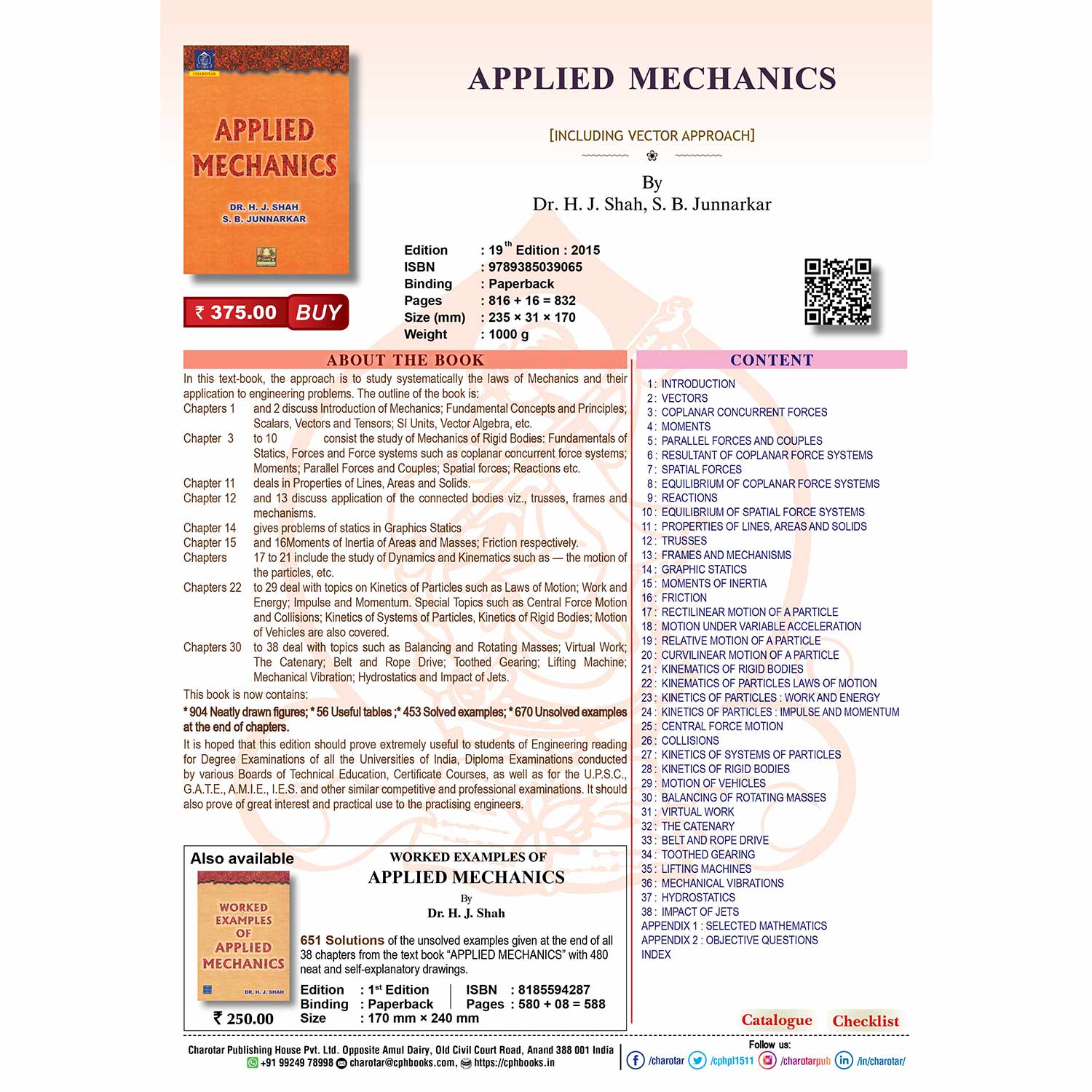
Content
1 : INTRODUCTION
2 : VECTORS
3 : COPLANAR CONCURRENT FORCES
4 : MOMENTS
5 : PARALLEL FORCES AND COUPLES
6 : RESULTANT OF COPLANAR FORCE SYSTEMS
7 : SPATIAL FORCES
8 : EQUILIBRIUM OF COPLANAR FORCE SYSTEMS
9 : REACTIONS
10 : EQUILIBRIUM OF SPATIAL FORCE SYSTEMS
11 : PROPERTIES OF LINES, AREAS AND SOLIDS
12 : TRUSSES
13 : FRAMES AND MECHANISMS
14 : GRAPHIC STATICS
15 : MOMENTS OF INERTIA
16 : FRICTION
17 : RECTILINEAR MOTION OF A PARTICLE
18 : MOTION UNDER VARIABLE ACCELERATION
19 : RELATIVE MOTION OF A PARTICLE
20 : CURVILINEAR MOTION OF A PARTICLE
21 : KINEMATICS OF RIGID BODIES
22 : KINEMATICS OF PARTICLES LAWS OF MOTION
23 : KINETICS OF PARTICLES : WORK AND ENERGY
24 : KINETICS OF PARTICLES : IMPULSE AND MOMENTUM
25 : CENTRAL FORCE MOTION
26 : COLLISIONS
27 : KINETICS OF SYSTEMS OF PARTICLES
28 : KINETICS OF RIGID BODIES
29 : MOTION OF VEHICLES
30 : BALANCING OF ROTATING MASSES
31 : VIRTUAL WORK
32 : THE CATENARY
33 : BELT AND ROPE DRIVE
34 : TOOTHED GEARING
35 : LIFTING MACHINES
36 : MECHANICAL VIBRATIONS
37 : HYDROSTATICS
38 : IMPACT OF JETS
Appendix 1 : Selected mathematics
Appendix 2 : Objective questions
INDEX
Catalogue
Checklist
Detailed Contents
[vc_row][vc_column][vc_tta_tabs][vc_tta_section title=”Page 1″ tab_id=”1583992302519-7525c8ce-cb8a”][vc_column_text]
Chapter 1 Introduction
1-1. Mechanics
1-2. Fundamental concepts
1-3. Scalars, vectors and tensors
1-4. Fundamental principles
1-5. System of units: SI units
1-6. Using SI units
Questions I
Chapter 2 vectors
2-1. Vectors
2-2. Basic operations with vectors
2-3. Components, unit vectors and position vector
2-4. Vector algebra: Dot product
2-5. Vector algebra: Cross product
2-6. Triple product of vectors
Exercise II
Chapter 3 coplanar concurrent forces
3-1. Forces and force systems
3-2. Principle of transmissibility
3-3. Resultant of a force system
3-4. Resultant of two coplanar concurrent forces
3-5. Resultant of several coplanar forces acting at a point: Law of
polygon of forces
3-6. Resolution of a force
3-7. Resultant of a coplanar concurrent force system: Resolution
method
Examples III
Chapter 4 Moments
4-1. Moment of a force
4-2. Principle of moments: Varignon’s theorem
4-3. Coplanar applications
4-4. Levers
4-5. A simple pulley
Examples IV
Chapter 5 Parallel forces and couples
5-1. Parallel force system
5-2. Couples
5-3. Equivalent couples
5-4. Addition of couples
5-5. Operations with couples
5-6. Equivalent systems of forces
5-7. Equipollent systems of vectors
Examples V
Chapter 6 Resultant of coplanar force systems
6-1. Introduction
6-2. Resultant of parallel force system
6-3. Centre of parallel forces
6-4. Resultant of a general coplanar force system
6-5. Concentrated and distributed loads
Examples VI
Chapter 7 Spatial forces
7-1. Concurrent forces in space
7-2. Moment of a force
7-3. Resultant of spatial force system
7-4. Wrench resultant
Examples VII
Chapter 8 equilibrium of coplanar force systems
8-1. Equilibrium
8-2. Equilibrium of a particle
8-3. Resultant and equilibrant
8-4. Principle of action and reaction
8-5. Free body and free body diagram
8-6. Tensions of strings
8-7. Equilibrium of three forces acting on a particle: Lami’s theorem
8-8. Equilibrium of a particle under three forces acting on it
8-9. External and internal forces
8-10. Tension and compression
8-11 Connected bodies
8-12. Equilibrium of a rigid body
8-13. Conditions of equilibrium for a system of coplanar forces
acting on a body
8-14. Types of supports
8-15. Solution of problems
Examples VIII
Chapter 9 reactions
9-1. Axial and transverse forces
9-2. Structural members
9-3. Types of beams
9-4. Reactions by proportions
9-5. Reactions by equations of statics: Principle of super-position
9-6. Determinate and indeterminate beams/structures
Examples IX
Chapter 10 Equilibrium of SPATIAL FORCE SYSTEMS
10-1. Equilibrium of spatial force systems
Examples X
Chapter 11 properties of lines, areas and solids
11-1. Introductory
11-2. Centre of gravity
11-3. Centre of mass
11-4. Centroids
11-5. First moment of an element of line and area
11-6. First moment of a line segment and a finite area
11-7. Centroids of lines and areas
11-8. Centroids of symmetrical lines and areas
11-9. Centroids by integration
11-10. Summary of centroids of common figures
11-11. Centroids of composite lines and areas
11-12. Theorems of Pappus — Guldinus
11-13. Centroid of volumes
Examples XI’
Chapter 12 Trusses
12-1. Engineering applications of connected bodies
TRUSSES
12-2. Introductory
12-3. Assumptions made in the analysis of a truss
12-4. Truss notations
12-5. Common types of trusses
12-6. Analysis of a truss
12-7. Method of joints
12-8. Method of sections
12-9. Determinateness of a truss
12-10. Truss with two hinges
12-11. Space trusses
Examples XII
Chapter 13 Frames and mechanisms
13-1. Frames and mechanisms
Examples XIII
Chapter 14 Graphic statics
14-1. Introductory
14-2. Basic concepts
14-3. Conditions of equilibrium of a point
14-4. Three force equilibrium of coplanar, non-concurrent, non-parallel
forces
14-5. Resultant of non-concurrent, non-parallel forces: Funicular
polygon
14-6. Resultant of parallel forces
14-7. Parallel forces: Centroid problems
14-8. Graphical conditions of rigid body equilibrium
14-9. Reactions of beams and trusses
14-10. Graphical methods applied to trusses
14-11. Force diagrams for individual joints of a truss
14-12. The Maxwell diagram
14-13. Method of substitution
14-14. Truss with two hinges with inclined loads
Examples XIV
[/vc_column_text][/vc_tta_section][vc_tta_section title=”Page 2″ tab_id=”1583992302533-7ec1a47a-97cd”][vc_column_text]
Chapter 15 moments of inertia
15-1. Introduction
Area Moment of Inertia
15-2. Definitions
15-3. Radius of gyration
15-4. Parallel axis theorem
15-5. Moment of inertia by integration
15-6. Moment of inertia of composite areas
15-7. Graphical method for first and second moments of a plane
section about an axis in its plane
15-8. Product of inertia
Moment of Inertia of Masses
15-9. Definitions
15-10. Parallel axis theorem
15-11. Moment of inertia of thin plates
15-12. Moments of inertia of standard forms
15-13. Moment of inertia of composite bodies
Examples XV
Chapter 16 Friction
16-1. Introduction
16-2. Types of friction
16-3. Characteristics of dry friction
16-4. Angle of friction: Cone of friction
16-5. Angle of repose
16-6. Types of problems
16-7. Equilibrium on a rough inclined plane
Applications of Friction
16-8. The wedge
16-9. The screw
16-10. Screw-jack
16-11. Journal bearings, axle friction
16-12. Thrust bearings: Disc friction
16-13. Thrust bearing: Uniform wear
16-14. Friction plate clutches
16-15. Rolling resistance
Examples XVI
Chapter 17 Rectilinear motion of a particle
17-1. Motion of a particle
17-2. Speed
17-3. Velocity
Rectilinear motion
17-4. Definitions
17-5. Motion under constant acceleration
17-6. Motion under gravity
Examples XVII
Chapter 18 Motion under variable acceleration
18-1. Motion under variable acceleration
18-2. Vector calculus
Examples XVIII
Chapter 19 Relative motion of a particle
19-1. Relative motion of a particle
19-2. Motion of connected particles
Examples XIX
Chapter 20 Curvilinear motion of a particle
20-1. Introductory
20-2. Velocity, Acceleration and Hodograph
20-3. Rectangular components of curvilinear motion
20-4. Normal and tangential components: Intrinsic co-ordinates
20-5. Radial and transverse components: Cylindrical co-ordinates
20-6. Angular motion of a line
20-7. Circular motion of a particle
20-8. Simple Harmonic Motion
20-9. Projectiles: Motion in a vertical plane under gravity
20-10. Motion of a projectile on an inclined plane
Examples XX
Chapter 21 Kinematics of rigid bodies
21-1. Introduction
21-2. Translation
21-3. Fixed axis rotation
21-4. General plane motion
21-5. Absolute motion analysis
21-6. Relative motion analysis
21-7. Instantaneous centre: Centrodes
Examples XXI
Chapter 22 Kinematics of particles: laws of motion
22-1. Introduction
22-2. Inertia and mass: Inertia
22-3. Newton’s laws of motion: First law
22-4. Newton’s second law
22-5. Inertial frame
22-6. Equations of motion
22-7. Constant force acting on a particle
22-8. Variable force acting on a particle
22-9. Motion of a lift
22-10. Motion on a rough inclined plane
22-11. Motion of connected bodies
22-12. D’Alembert’s principle: Dynamic equilibrium
22-13. Curvilinear motion
22-14. Circular motion
22-15. Newton’s law of gravitation
Examples XXII
Chapter 23 Kinetics of Particles: work and energy
23-1. Introductory
Work and energy method
23-2. Work done by a force
23-3. Standard cases
23-4. Power and efficiency
23-5. Energy
23-6. Conservative forces
23-7. Principle of conservation of energy
23-8. Total mechanical energy
23-9. Extraneous forces
Examples XXIII
Chapter 24 Kinetics of Particles: impulse and momentum
24-1. Linear momentum
24-2. Linear impulse
24-3. Variable force with time
24-4. Impulsive forces
24-5. Angular momentum
24-6. Angular impulse
Examples XXIV
Chapter 25 Central force motion
25-1. Introductory
25-2. Central force motion
25-3. Trajectory of a particle under a central force
25-4. Launching of a space vehicle
25-5. Escape velocity: Particle orbits
25-6. Periodic time of an orbit
25-7 Communication satellite
25-8. Kepler’s laws of planetary motion
Examples XXV
Chapter 26 Collisions
26-1. Collision of two bodies: Impact
26-2. Definitions
26-3. Phenomenon of impact
26-4. The general condition
26-5. Collision of perfectly elastic bodies
26-6 Inelastic collisions
26-7. Collision of partially elastic bodies
26-8. Oblique impact on a smooth horizontal plane
26-9. Oblique impact of two smooth spheres
Examples XXVI
[/vc_column_text][/vc_tta_section][vc_tta_section title=”Page 3″ tab_id=”1583992726006-92df9525-4050″][vc_column_text]
Chapter 27 Kinetics of systems of particles
27-1. Introduction
27-2. Application of law of motion for system of particles
27-3. Principle of motion of mass centre
27-4. Work-energy
27-5. Linear and angular momentum of a system of particles
27-6. Principle of impulse and momentum for a system of particles
Examples XXVII
Chapter 28 Kinetics of rigid bodies
28-1. Introduction
28-2. Translation
Rotation
28-3. Rotational motion
28-4. Work done by a couple: Kinetic energy of rotation
28-5. Impulse and momentum
Plane motion
28-6. Wheel rolling without slipping
Special topics
28-7. Flywheels
28-8. Centre of Percussion
Examples XXVIII
Chapter 29 Motion of vehicles
29-1. Motion of vehicles
29-2. Tractive resistance
29-3. Tractive force
29-4. Driving torque
29-5. Maximum possible tractive effort
29-6. Power to drive a vehicle
29-7. A truck rolling down a rough inclined plane
29-8. Motion of a truck along level track
29-9. Motion of a truck going round a curve
29-10. Banking a curve: Super-elevation
Examples XXIX
Chapter 30 Balancing of rotating masses
30-1. Static and Dynamic balance
30-2. Balancing of several masses in the same plane of
revolution
30-3. Dynamical loads at bearings
30-4. Balancing of a mass by two masses in different planes of
revolution
Examples XXX
Chapter 31 Virtual work
31-1. Introductory
31-2. Principle of virtual work
Examples XXXI
Chapter 32 The catenary
32-1. The Catenary
32-2. The parabolic chain
32-3. The length of the cable
Examples XXXII
Chapter 33 belt and rope drive
33-1. Belt drive
33-2. Velocity ratio
33-3. Compound belt drive
33-4. Length of belt: Open drive
33-5. Length of belt: Crossed drive
33-6. Transmission of power
33-7. Centrifugal tension
33-8. Optimum speed for maximum power
33-9. Rope drive
Examples XXXIII
Chapter 34 Toothed Gearing
34-1. Introduction
34-2. Friction wheels
34-3. Toothed wheels: Definitions
34-4. Motion transmitted by toothed gearing
34-5. Forms of wheel teeth
34-6. Trains of wheels
34-7. Design of wheel trains
34-8. Wheel train for a 12-hour clock
34-9. Screw-cutting Lathe
34-10. Lathe back-gear for speed reduction
34-11. Three-speed gear-box of a motor car
34-12. Epicyclic gearing
34-13. Epicyclic trains with bevel wheels
34-14. Humpage’s speed-reduction gear
34-15. The differential gear
34-16. Epicyclic gearing: alternate method
Examples XXXIV
Chapter 35 Lifting Machines
35-1. Definitions
35-2. Basic machines
35-3. Differential wheel and axle
35-4. Differential pulley-block
35-5. Differential screw
35-6. Pulley-blocks
35-7. Lifting machines with toothed gearing
35-8. Worm gearing
35-9. Worm geared screw jack
35-10. Worm geared pulley block
35-11. Linear law of machines
35-12. Reversibility of a machine
35-13. Compound efficiency
Examples XXXV
Chapter 36 Mechanical Vibrations
36-1. Introduction
36-2. Classification of vibrations
36-3. Vibration parameters
36-4. Free undamped vibrations of a particle: Spring-mass system
36-5. Composite springs
36-6. Simple pendulum
36-7. Conical pendulum
36-8. Compound pendulum
Examples XXXVI
Chapter 37 Hydrostatics
37-1. Introductory: Fluids and liquids
37-2. Liquid pressure
37-3. Relation of pressure to depth in a liquid
37-4. Total thrust on a plane vertical area immersed in a liquid:
Centre of Pressure
37-5. Total thrust on an inclined plane area immersed in a liquid
37-6. Floatation and Buoyancy
Conditions of Equilibrium of a Floating Body
37-7. Metacentre
37-8. Metacentric height
Examples XXXVII
Chapter 38 Impact of jets
38-1. Force exerted by a jet
38-2. Flat plates: Stationary as well as moving
38-3. Curved vanes
38-4. Pelton wheel: Turbines
Examples XXXVIII
Appendix 1 Selected mathematics
Appendix 2 Objective questions
Index
[/vc_column_text][/vc_tta_section][/vc_tta_tabs][/vc_column][/vc_row]










Reviews
There are no reviews yet.