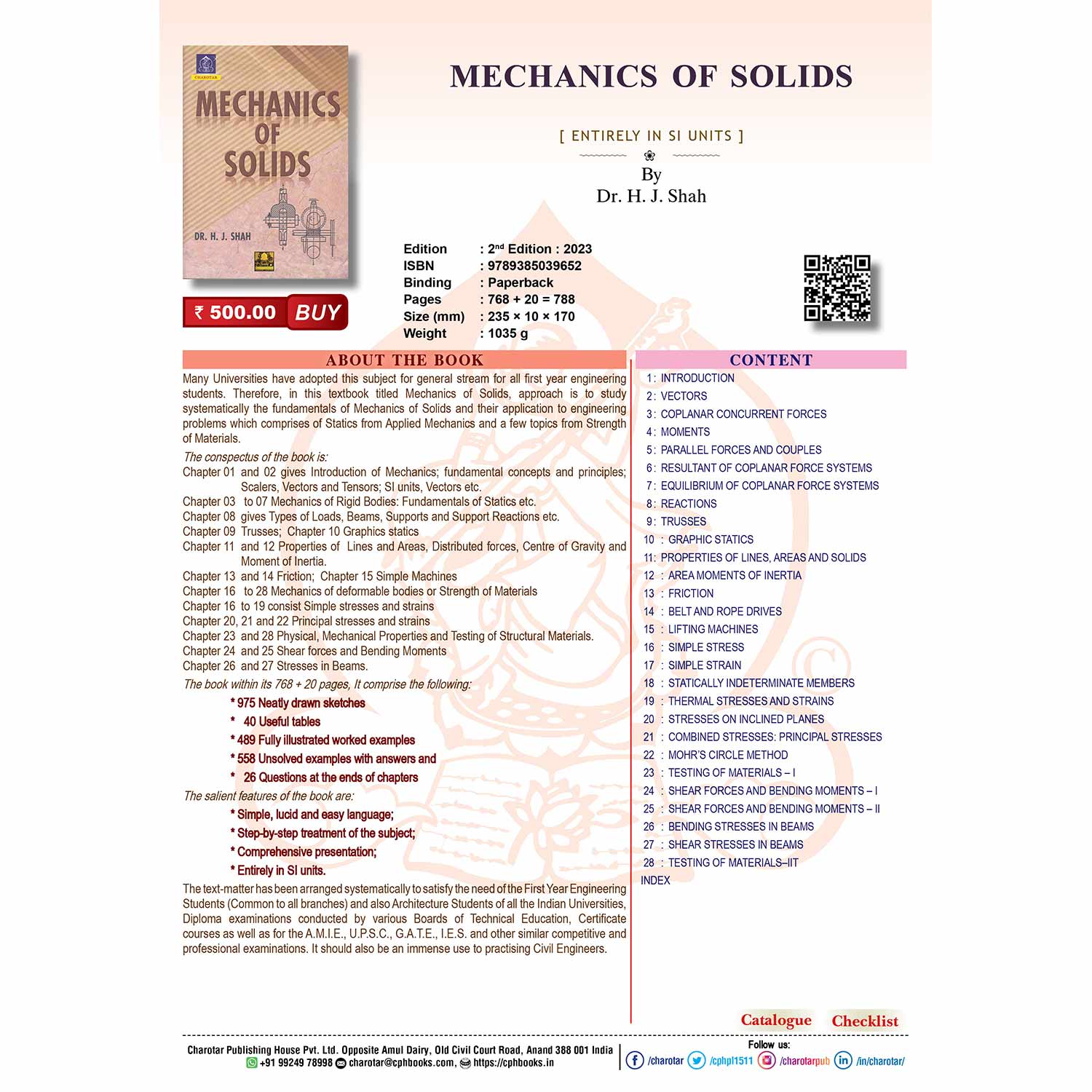
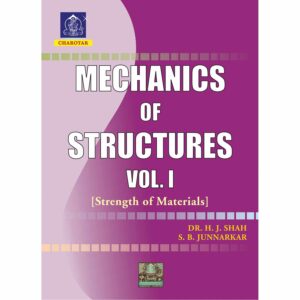
Content
1 : INTRODUCTION
2 : VECTORS
3 : COPLANAR CONCURRENT FORCES
4 : MOMENTS
5 : PARALLEL FORCES AND COUPLES
6 : RESULTANT OF COPLANAR FORCE SYSTEMS
7 : EQUILIBRIUM OF COPLANAR FORCE SYSTEMS
8 : REACTIONS
9 : TRUSSES
10 : GRAPHIC STATICS
11: PROPERTIES OF LINES, AREAS AND SOLIDS
12 : AREA MOMENTS OF INERTIA
13 : FRICTION
14 : BELT AND ROPE DRIVES
15 : LIFTING MACHINES
16 : SIMPLE STRESS
17 : SIMPLE STRAIN
18 : STATICALLY INDETERMINATE MEMBERS
19 : THERMAL STRESSES AND STRAINS
20 : STRESSES ON INCLINED PLANES
21 : COMBINED STRESSES: PRINCIPAL STRESSES
22 : MOHR’S CIRCLE METHOD
23 : TESTING OF MATERIALS – I
24 : SHEAR FORCES AND BENDING MOMENTS – I
25 : SHEAR FORCES AND BENDING MOMENTS – II
26 : BENDING STRESSES IN BEAMS
27 : SHEAR STRESSES IN BEAMS
28 : TESTING OF MATERIALS–IIT
INDEX
Details Content
[vc_row][vc_column][vc_tta_tabs][vc_tta_section title=”Page 1″ tab_id=”1584092483852-d06a0486-b9a8″][vc_column_text]
Chapter 1 INTRODUCTION
1-1. Mechanics
1-2. Fundamental concepts
1-3. Scalars, vectors and tensors
1-4. Fundamental principles
1-5. System of units: SI units
BASIC SI UNITS
1-6. Using SI units
Questions I
Chapter 2 VECTORS
2-1. Vectors
2-2. Basic operations with vectors
2-3. Components, unit vectors and position vector
2-4. Vector algebra: Dot product
2-5. Vector algebra: Cross product
2-6. Triple product of vectors
Examples II
Chapter 3 COPLANAR CONCURRENT FORCES
3-1. Forces and force systems
3-2. Principle of transmissibility
3-3. Resultant of a force system
3-4. Resultant of two coplanar concurrent forces
3-5. Resultant of several coplanar forces acting at a point: Law of
polygon of forces
3-6. Resolution of a force
3-7. Resultant of a coplanar concurrent force system: Resolution
method
Examples III
Chapter 4 MOMENTS
4-1. Moment of a force
4-2. Principle of moments: Varignon’s theorem
4-3. Coplanar applications
4-4. Levers
4-5. A simple pulley
Examples IV
Chapter 5 PARALLEL FORCES AND COUPLES
5-1. Parallel force system
5-2. Couples
5-3. Equivalent couples
5-4. Addition of couples
5-5. Operations with couples
5-6. Equivalent systems of forces
5-7. Equipollent systems of vectors
Examples V
Chapter 6 RESULTANT OF COPLANAR FORCE SYSTEMS
6-1. Introduction
6-2. Resultant of parallel force system
6-3. Centre of parallel forces
6-4. Resultant of a general coplanar force system
6-5. Concentrated and distributed loads
Examples VI
Chapter 7 EQUILIBRIUM OF COPLANAR FORCE SYSTEMS
7-1. Equilibrium
EQUILIBRIUM OF A PARTICLE
7-2. Equilibrium of a particle
7-3. Resultant and equilibrant
7-4. Principle of action and reaction
7-5. Free body and free body diagram
7-6. Tensions of strings
7-7. Equilibrium of three forces acting on a particle: Lami’s theorem
7-8. Equilibrium of a particle under three forces acting on it
7-9. External and internal forces
7-10. Tension and compression
7-11. Connected bodies
EQUILIBRIUM OF A RIGID BODY
7-12. Equilibrium of a rigid body
7-13. Conditions of equilibrium for a system of coplanar forces
acting on a body
7-14. Types of supports
7-15. Solution of problems
Examples VII
Chapter 8 REACTIONS
8-1. Axial and transverse forces
8-2. Structural members
8-3. Types of beams
8-4. Reactions by proportions
8-5. Reactions by equations of statics: Principle of super-position
8-6. Determinate and indeterminate beams/structures
Examples VIII
Chapter 9 TRUSSES
9-1. Engineering applications of connected bodies
TRUSSES
9-2. Introductory
9-3. Assumptions made in the analysis of a truss
9-4. Truss notations
9-5. Common types of trusses
9-6. Analysis of a truss
9-7. Method of joints
9-8. Method of sections
9-9. Determinateness of a truss
9-10. Truss with two hinges
Examples IX
Chapter 10 GRAPHIC STATICS
10-1. Introductory
10-2. Basic concepts
10-3. Conditions of equilibrium of a point
10-4. Three force equilibrium of coplanar, non-concurrent, non-parallel
forces
10-5. Resultant of non-concurrent, non-parallel forces: Funicular
polygon
10-6. Resultant of parallel forces
10-7. Parallel forces: Centroid problems
10-8. Graphical conditions of equilibrium
10-9. Reactions of beams and trusses
10-10. Graphical methods applied to trusses
10-11. Force diagrams for individual joints of a truss
10-12. The Maxwell diagram
10-13. Method of substitution
10-14. Truss with two hinges with inclined loads
Examples X
Chapter 11 PROPERTIES OF LINES, AREAS AND SOLIDS
11-1. Introductory
11-2. Centre of gravity
11-3. Centre of mass
11-4. First moment of an element of line and area
11-5. First moment of a line segment and a finite area
11-6. Centroids of lines and areas
11-7. Centroids of symmetrical lines and areas
11-8. Centroids by integration
11-9. Summary of centroids of common figures
11-10. Centroids of composite areas
11-11. Theorems of Pappus—Guldinus
11-12. Centroid of volumes
Examples XI
[/vc_column_text][/vc_tta_section][vc_tta_section title=”Page 2″ tab_id=”1584092483875-d6924d4d-7fa4″][vc_column_text]
Chapter 12 AREA MOMENTS OF INERTIA
12-1. Introduction
12-2. Definitions
12-3. Radius of gyration
12-4. Parallel axis theorem
12-5. Moment of inertia by integration
12-6. Moment of inertia of composite areas
12-7. Product of inertia
Examples XII
Chapter 13 FRICTION
13-1. Introduction
13-2. Types of friction
13-3. Characteristics of dry friction
13-4. Angle of friction: Cone of friction
13-5. Angle of repose
13-6. Types of problems
13-7. Equilibrium on a rough inclined plane
APPLICATIONS OF FRICTION
13-8. The wedge
13-9. The screw
13-10. Screw-jack
13-11. Journal bearings, axle friction
13-12. Thrust bearings: Disc friction
13-13. Thrust bearing: Uniform wear
13-14. Friction plate clutches
13-15. Rolling resistance
Examples XIII
Chapter 14 BELT AND ROPE DRIVES
14-1. Belt drive
14-2. Velocity ratio
14-3. Compound belt drive
14-4. Length of belt: Open drive
14-5. Length of belt: Crossed drive
14-6. Transmission of power
14-7. Centrifugal tension
14-8. Optimum speed for maximum power
14-9. Rope drive
Examples XIV
Chapter 15 LIFTING MACHINES
15-1. Definitions
15-2. Basic machines
15-3. Differential wheel and axle
15-4. Differential pulley-block
15-5. Differential screw
15-6. Pulley-blocks
15-7. Lifting machines with toothed gearing
15-8. Worm gearing
15-9. Worm geared screw jack
15-10. Worm geared pulley block
15-11. Linear law
15-12. Reversibility of a machine
15-13. Compound efficiency
Examples XV
Chapter 16 SIMPLE STRESS
16-1. Introduction to Mechanics of deformable bodies
16-2. Loading a bar
16-3. Principle of superposition
16-4. Classification of loaded bar
16-5. Gradual, sudden, impact and shock loading
16-6. Tension and compression
16-7. Resistance of an axially loaded bar
16-8. Concept of a stress
16-9. Normal stresses
16-10. Simple stress
16-11. Design of an axially loaded member
16-12. Non-prismatic bars
16-13. Axial force diagram
16-14. Rotating rings
16-15. Shear
16-16. Shear stress
16-17. Pure shear
16-18. Bearing stress
Examples XVI
Chapter 17 SIMPLE STRAIN
17-1. Introduction
17-2. Linear strain
17-3. Shear strain
17-4. Elasticity
17-5. Hooke’s law
17-6. Axial and shear deformations
17-7. Bars of varying section
17-8. Bars of uniformly varying cross-section
17-9. A bar subjected to self-weight
17-10. Bar of uniform strength
17-11. Bars subjected to uniformly varying loads
17-12. Pin-jointed determinate frames
17-13. Lateral strain: Poisson’s ratio
17-14. Biaxial and triaxial deformations
Examples XVII
Chapter 18 STATICALLY INDETERMINATE MEMBERS
18-1. Introduction
18-2. Composite bars
18-3. Equivalent modulus of a composite bar
18-4. Pin-jointed bars
18-5. Stresses due to lack of fit
Examples XVIII
Chapter 19 THERMAL STRESSES AND STRAINS
19-1. Introduction
19-2. General
19-3. Coefficient of linear expansion
19-4. Stresses due to changes of temperature
19-5. Compound bar
19-6. Composite bar
19-7. Bars of uniformly varying cross-section
19-8. Shrinking-on
Examples XIX
Chapter 20 STRESSES ON INCLINED PLANES
20-1. Introduction
20-2. Stresses on inclined plane of a bar under tension or compression
20-3. State of pure shear: Stresses on inclined planes
20-4. Linear strain of the diagonal BD
20-5. Relation between the Moduli of Elasticity and Rigidity for a
given material
20-6. Bulk Modulus
20-7. Relation between three elastic constants
Examples XX
Chapter 21 COMBINED STRESSES: PRINCIPAL STRESSES
21-1. Introduction
21-2. Stress components
21-3. Element subjected to general plane stress system
21-4. Principal planes and principal stresses
21-5. Planes carrying maximum shear stress
21-6. Element subjected to principal stresses
Examples XXI
[/vc_column_text][/vc_tta_section][vc_tta_section title=”Page 3″ tab_id=”1584092503992-b4b6c5fe-3d4e”][vc_column_text]
Chapter 22 MOHR’S CIRCLE METHOD
22-1. Mohr’s circle method
Examples XXII
Chapter 23 TESTING OF MATERIALS – I
23-1. Introduction
23-2. Metals and alloys
23-3. Testing machines
Tension Tests
23-4. The complete tensile test
23-5. Stress–strain diagram
23-6. Mechanical properties of materials
23-7. Modulus of elasticity
23-8. Yield point by the offset method: Proof stress
23-9. Secant modulus
23-10. Specific modulus of elasticity
23-11. Resilience
23-12. Toughness
Compression Tests
23-13. The compression test
23-14. Compression tests on wood and concrete
23-15. Permissible stress: Factor of safety
Stress Concentration
23-16. Stress concentration
23-17. Stress concentration factor
23-18. Importance of stress concentration under different loads
23-19. Elastoplastic materials: Limit design
Examples XXIII
Chapter 24 SHEAR FORCES AND BENDING MOMENTS – I
24-1. Introductory
24-2. Types of beams
24-3. Actions on the cross-section of a beam
24-4. Sign conventions
24-5. Shear Force (S.F.) and Bending Moment (B.M.) diagrams
24-6. Cantilevers
24-7. Simply supported beams
24-8. Relation between the S.F. and the B.M. at a cross-section of
a beam
24-9. Overhanging beams
Examples XXIV
Chapter 25 SHEAR FORCES AND BENDING MOMENTS – II
25-1. Introduction
25-2. S.F. and B.M. diagrams for beams with variable loading
25-3. Beams with end couples
25-4. Beams with an intermediate couple
25-5. Supports offering pressures
25-6. Cantilever structures
25-7. Principle of superposition
25-8. Moment and loading diagrams drawn from shear diagrams
25-9. Beams subjected to inclined loads
25-10. Inclined beams
25-11. Graphical methods
Examples XV
Chapter 26 BENDING STRESSES IN BEAMS
26-1. Simple bending
26–2. Theory of simple bending
26-3. Modulus of section or section modulus
26-4. Application of bending equation
26-5. Modulus of rupture
26-6. Beams of rectangular section
26-7. Strength of sections
26-8. Economic sections
26-9. Unsymmetrical and built-up sections
26-10. Modulus figure
26-11. Beam of uniform strength
26-12. Strain energy in flexure
26-13. Laminated springs
Examples XVI
Chapter 27 SHEAR STRESSES IN BEAMS
27-1. Resistance to shear force: shear stresses
27-2. Shear flow
27-3. Shear stresses in beams of rectangular and circular sections
27-4. Shear stresses in beams of I-section
27-5. Assumptions and limitations of the shear stresses formula
27-6. Shear stresses in built-up sections
27-7. Beam of square section with one diagonal horizontal
27-8. Design for flexure and shear
27-9. Principal stresses and Principal planes at a point in a beam
section
27-10. Curves of principal stresses
27-11. Principal stresses in an I-section
27-12. Strain-energy due to shear in a beam
Examples XVII
Chapter 28 TESTING OF MATERIALS–II
28-1. Flexure tests
28-2. Important flexure tests
28-3. Shear tests
28-4. Hardness
28-5. Brinell hardness test
28-6. Rockwell hardness test
28-7. Impact tests
28-8. Fatigue
28-9. Stress spectrum
28-10. Fatigue tests
28-11. S-N curve
28-12. Endurance limit or fatigue limit
28-13. Fatigue failure
Examples XXVIII
Questions
Index
[/vc_column_text][/vc_tta_section][/vc_tta_tabs][/vc_column][/vc_row]


Reviews
There are no reviews yet.