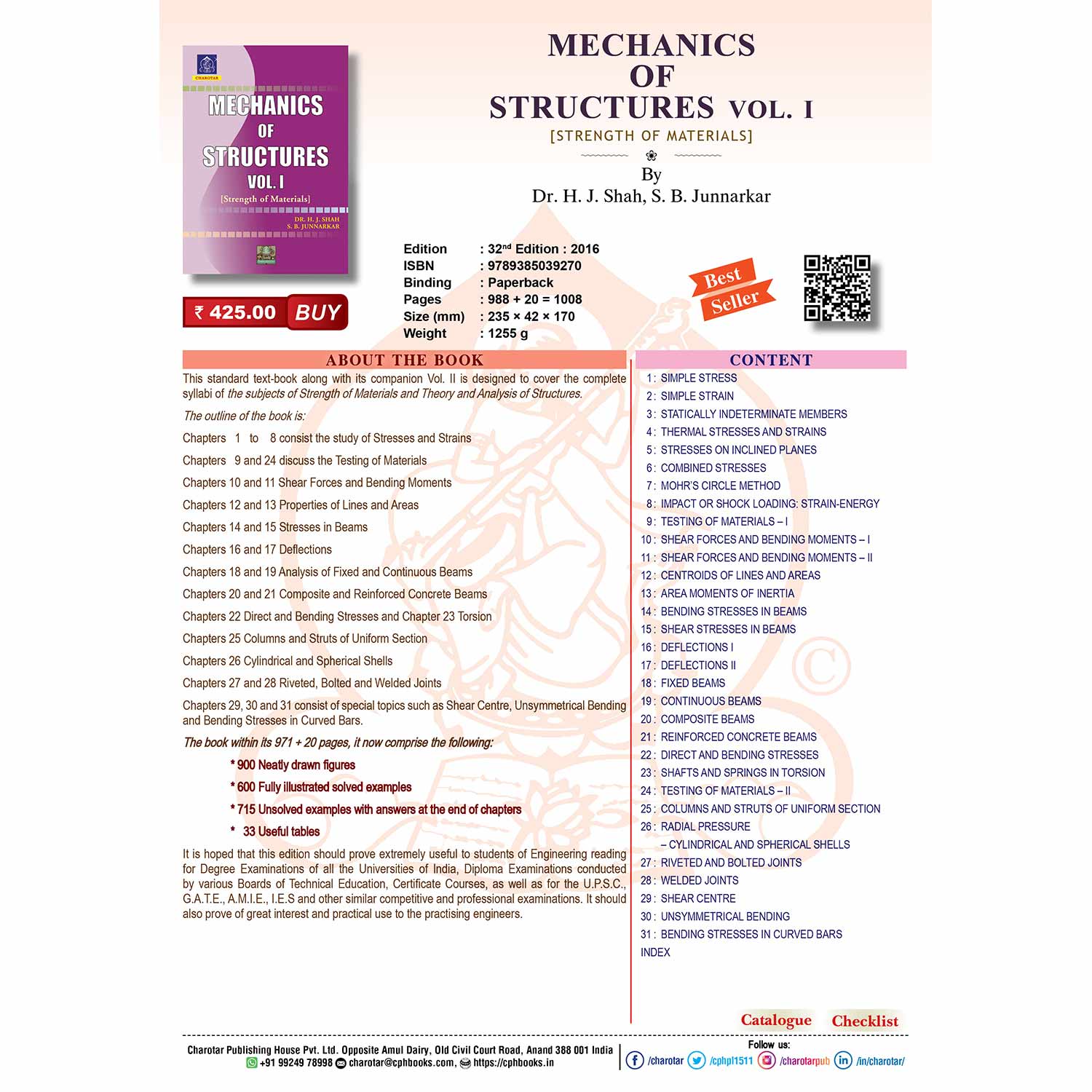
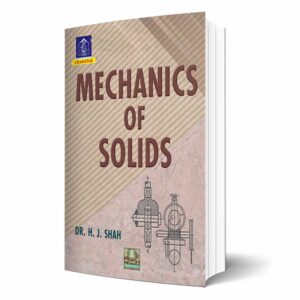
Content
1 : SIMPLE STRESS
2 : SIMPLE STRAIN
3 : STATICALLY INDETERMINATE MEMBERS
4 : THERMAL STRESSES AND STRAINS
5 : STRESSES ON INCLINED PLANES
6 : COMBINED STRESSES
7 : MOHR’S CIRCLE METHOD
8 : IMPACT OR SHOCK LOADING: STRAIN-ENERGY
9 : TESTING OF MATERIALS – I
10 : SHEAR FORCES AND BENDING MOMENTS – I
11 : SHEAR FORCES AND BENDING MOMENTS – II
12 : CENTROIDS OF LINES AND AREAS
13 : AREA MOMENTS OF INERTIA
14 : BENDING STRESSES IN BEAMS
15 : SHEAR STRESSES IN BEAMS
16 : DEFLECTIONS I
17 : DEFLECTIONS II
18 : FIXED BEAMS
19 : CONTINUOUS BEAMS
20 : COMPOSITE BEAMS
21 : REINFORCED CONCRETE BEAMS
22 : DIRECT AND BENDING STRESSES
23 : SHAFTS AND SPRINGS IN TORSION
24 : TESTING OF MATERIALS – II
25 : COLUMNS AND STRUTS OF UNIFORM SECTION
26 : RADIAL PRESSURE
– CYLINDRICAL AND SPHERICAL SHELLS
27 : RIVETED AND BOLTED JOINTS
28 : WELDED JOINTS
29 : SHEAR CENTRE
30 : UNSYMMETRICAL BENDING
31 : BENDING STRESSES IN CURVED BARS
INDEX
Detailed Content
[vc_row][vc_column][vc_tta_tabs][vc_tta_section title=”Page 1″ tab_id=”1584076235133-d438b08c-de42″][vc_column_text]
Chapter 1 SIMPLE STRESS
1-1. Introduction to Mechanics of deformable bodies
1-2. Loading a bar
1-3. Principle of superposition
1-4. Classification of loaded bar
1-5. Gradual, sudden, impact and shock loading
1-6. Tension and compression
1-7. Resistance of an axially loaded bar
1-8. Concept of a stress
1-9. Normal stresses
1-10. Simple stress
1-11. Design of an axially loaded member
1-12. Non-prismatic bars
1-13. Axial force diagram
1-14. Rotating rings
1-15 Shear
1-16. Shear stress
1-17. Pure shear
1-18. Bearing stress
Examples I
Chapter 2 SIMPLE STRAIN
2-1 Introduction
2-2. Linear strain
2-3. Shear strain
2-4. Elasticity
2-5. Hooke’s law
2-6. Axial and shear deformations
2-7. Bars of varying section
2-8. Bars of uniformly varying cross-section
2-9. A bar subjected to self-weight
2-10. Bar of uniform strength
2-11. Bars subjected to uniformly varying loads
2-12. Pin-jointed determinate frames
2-13. Lateral strain: Poisson’s ratio
2-14. Biaxial and triaxial deformations
Examples II
Chapter 3 STATICALLY INDETERMINATE MEMBERS
3-1. Introduction
3-2. Composite bars
3-3. Equivalent modulus of a composite bar
3-4. Pin-jointed bars
3-5. Stresses due to lack of fit
Examples III
Chapter 4 THERMAL STRESSES AND STRAINS
4-1. Introduction
4-2. General
4-3. Coefficient of linear expansion
4-4. Stresses due to changes of temperature
4-5. Compound bar
4-6. Composite bar
4-7. Bars of uniformly varying cross-section
4-8. Shrinking-on
Examples IV
Chapter 5 STRESSES ON INCLINED PLANES
5-1. Introduction
5-2. Stresses on inclined plane of a bar under tension or compression
5-3. State of pure shear: Stresses on inclined planes
5-4. Linear strain of the diagonal BD
5-5. Relation between the Moduli of Elasticity and Rigidity for a
given material
5-6. Bulk Modulus
5-7. Relation between three elastic constants
Examples V
Chapter 6 COMBINED STRESSES
6-1. Introduction
6-2. Stress components
6-3. Element subjected to general plane stress system
6-4. Principal planes and principal stresses
6-5. Planes carrying maximum shear stress
6-6. Element subjected to principal stresses
Examples VI
Chapter 7 MOHR’S CIRCLE METHOD
7-1. Mohr’s circle method
Sign conventions
Rules and construction
Examples VII
Chapter 8 IMPACT OR SHOCK LOADING: STRAIN-ENERGY
8-1. Introductory
Axial Loading
8-2. Strain-Energy: Resistance-deformation diagram
8-3. Gradual, sudden, impact and shock loading
8-4. Limitations
Shear Loading
8-5. Shear Resilience
8-6. Strain-energy in terms of principal stresses
8-7. Relation between the elastic moduli
8-8. Criteria for design
Examples VIII
Chapter 9 TESTING OF MATERIALS – I
9-1. Introduction
9-2. Metals and alloys
9-3. Testing machines
Tension Tests
9-4. The complete tensile test
9-5. Stress–strain diagram
9-6. Physical properties of materials
9-7. Modulus of elasticity
9-8. Yield point by the offset method: Proof stress
9-9. Secant modulus
9-10. Specific modulus of elasticity
9-11. Resilience
9-12. Toughness
Compression tests
9-13. The compression test
9-14. Compression tests on wood and concrete
9-15. Permissible stress: Factor of safety
Stress concentration
9-16. Stress concentration
9-17. Stress concentration factor
9-18. Importance of stress concentration under different loads
9-19. Elastoplastic materials: Limit design
Examples IX
Chapter 10 SHEAR FORCES AND BENDING MOMENTS – I
10-1. Introductory
10-2. Types of beams
10-3. Actions on the cross-section of a beam
10-4. Sign conventions
10-5. Shear Force (S.F.) and Bending Moment (B.M.) diagrams
10-6. Cantilevers
10-7. Simply supported beams
10-8. Relation between the S.F. and the B.M. at a cross-section of
a beam
10-9. Overhanging beams
Examples X
[/vc_column_text][/vc_tta_section][vc_tta_section title=”Page 2″ tab_id=”1584076235153-22ab3d60-2411″][vc_column_text]
Chapter 11 SHEAR FORCES AND BENDING MOMENTS – II
11-1. Introduction
11-2. S.F. and B.M. diagrams for beams with variable loading
11-3. Beams with end couples
11-4. Beams with an intermediate couple
11-5. Supports offering pressures
11-6. Cantilever structures
11-7. Principle of superposition
11-8. Moment and loading diagrams drawn from shear diagrams
11-9. Beams subjected to inclined loads
11-10. Inclined beams
11-11. Graphical methods
Examples XI
Chapter 12 CENTROIDS OF LINES AND AREAS
12-1. Introduction
Centroids
12-2. First moment of an element of line and area
12-3. First moment of a line segment and a finite area
12-4. Centroids of lines and areas
12-5. Centroids of symmetrical lines and areas
12-6. Centroids by integration
12-7. Summary of centroids of common figures
12-8. Centroids of composite areas
Examples XII
Chapter 13 AREA MOMENTS OF INERTIA
13-1. Introduction
13-2. Definitions
13-3. Radius of gyration
13-4. Parallel axis theorem
13-5. Moment of inertia by integration
13-6. Moment of inertia of composite areas
13-7. Graphical method for first and second moments of a plane
section about an axis in its plane
13-8. Product of inertia
13-9. Moment of inertia with respect to inclined axes: Rotation of
axes
13-10. Principal moments of inertia: Principal axes
13-11. Mohr’s circle for moments of inertia
13-12. The Mohr Land circle of inertia
13-13. Momental ellipse
Examples XIII
Chapter 14 BENDING STRESSES IN BEAMS
14-1. Simple bending
14–2. Theory of simple bending
14-3. Modulus of section or section modulus
14-4. Application of bending equation
14-5. Modulus of rupture
14-6. Beams of rectangular section
14-7. Strength of sections
14-8. Economic sections
14-9. Unsymmetrical and built-up sections
14-10. The Modulus figure
14-11. Beam of uniform strength
14-12. Strain energy in flexure
14-13. Laminated springs
Examples XIV
Chapter 15 SHEAR STRESSES IN BEAMS
15-1. Resistance to shear force: shear stresses
15-2. Shear flow
15-3. Shear stresses in beams of rectangular and circular sections
15-4. Shear stresses in beams of I-section
15-5. Assumptions and limitations of the shear stresses formula
15-6. Shear stresses in built-up sections
15-7. Beam of square section with one diagonal horizontal
15-8. Design for flexure and shear
15-9. Principal stresses and Principal planes at a point in a beam
section
15-10. Curves of principal stresses
15-11. Principal stresses in an I-section
15-12. Strain-energy due to shear in a beam
Examples XV
Chapter 16 DEFLECTIONS I
16-1. Introductory
16-2. Use of deflection computations
16-3. Bending into a circular arc
16-4. Relation between slope deflection and radius of curvature
16-5. Axes of reference
16-6. Limitations of the equation of elastic line
16-7. Computations from basic equation
16-8. Using the principle of superposition
16-9. Cantilevers
16-10. Propped cantilevers
16-11. Simply supported beams
16-12. Relation between maximum stress and maximum deflection
16-13. Propped beams — Rigid and elastic props
16-14. Simply supported beam with an eccentric load W
16-15. Non-prismatic beams
16-16. Macaulay’s method
16-17. Variable loading on a beam of uniform section
16-18. Closure
Examples XVI
Chapter 17 DEFLECTIONS II
17-1. Moment area method
17-2. Method of elastic weights
17-3. Conjugate beam method
17-4. Impact loading on beams
17-5. Deflection by strain energy
17-6. Beams of variable section
17-7. Graphical methods
Examples XVII
Chapter 18 FIXED BEAMS
18-1. Introductory
Indeterminate Structures
18-2. Determinateness of the structure
18-3. Use of indeterminate structures
18-4. Methods of analysis
Fixed Beams
18-5. Fixed, built in, restrained or encastré beams
18-6. Method of superposition
18-7. Double integration method
18-8. Solution by moment area method
18-9. Sinking of support
18-10. Rotation of support
18-11. Review of deflection methods
18-12. Degree of restraint at supports for maximum bending moment
to be as small as possible
18-13. Beams with related deflections
Examples XVIII
Chapter 19 CONTINUOUS BEAMS
19-1. Continuous beams
19-2. The three moment theorem
19-3. Support settlement
Examples XIX
Chapter 20 COMPOSITE BEAMS
20-1. Introductory
20-2. Flitched beams
20-3. Equivalent section: Transformed area method
20-4. Deflection of composite beams
Examples XX
[/vc_column_text][/vc_tta_section][vc_tta_section title=”Page 3″ tab_id=”1584076435363-697f9d98-9e0f”][vc_column_text]
Chapter 21 REINFORCED CONCRETE BEAMS
21-1. Reinforced concrete
21-2. Compressive strength of concrete
21-3. Steel as reinforcement
21-4. Types of reinforcement
21-5. Mild steel bars
21-6. High yield strength deformed (HYSD) bars
21-7. Design of a beam
21-8. Classification of beams
21-9. Balanced, Under-reinforced and Over-reinforced design
21-10. Permissible stresses
21-11. Assumptions for flexure design
Singly Reinforced Beams
21-12. Derivation of formulae for balanced design
21-13. Transformed area method
21-14. Types of problems
Examples XXI
Chapter 22 DIRECT AND BENDING STRESSES
22-1. Introduction
22-2. Combined axial and flexural load
22-3. Biaxial loading
22-4. Eccentric loading
22-5. Limit of eccentricity
22-6. Double eccentricity
22-7. Wind pressure on walls and chimney shafts
22-8. Coefficient of wind-resistance
22-9. Water and earth pressure on walls
Examples XXII
Chapter 23 SHAFTS AND SPRINGS IN TORSION
23-1. Introduction
23-2. Assumptions
23-3. Derivation of torsion formulae
23-4. Power transmitted: design of shafts
23-5. Torque diagrams
23-6. Stepped shaft
23-7. Composite shafts and tapered shaft
23-8. Keys and couplings
23-9. Combined bending and torsion
23-10. Combined bending and torsion and axial thrust
23-11. Torsion resilience of shafts
23-12. Shafts of non-circular sections subjected to torsion
23-13. Closely coiled helical springs: Axial loading
23-14. Closely coiled helical springs: Axial moment
23-15. Open coiled helical springs
Examples XXIII
Chapter 24 TESTING OF MATERIALS – II
24-1. Flexure tests
24-2. Important flexure tests
24-3. Shear tests
24-4. Hardness
24-5. Brinell hardness test
24-6. Rockwell hardness test
24-7. Impact tests
24-8 Fatigue
24-9. Stress spectrum
24-10. Fatigue tests
24-11. The S-N curve
24-12. Endurance limit or fatigue limit
24-13. Fatigue failure
Examples XXIV
Chapter 25 COLUMNS AND STRUTS OF UNIFORM SECTION
25-1. Axial loading
25-2. Very long columns — Euler’s formula
25-3. Limitations of Euler’s formulae
25-4. Intermediate columns
25-5. Rankine’s formula
25-6. Design of struts and columns
25-7. Other empirical formulae
25-8. Long columns under eccentric loading
25-9. Prof. Perry’s formula
25-10. Initial curvature on long column: Axial loading
25-11. Perry-Robertson formula
25-12. B.I.S. formula
25-13. Struts with transverse loading
Examples XXV
Chapter 26 RADIAL PRESSURE – CYLINDRICAL AND
SPHERICAL SHELLS
26-1. Thin seamless cylindrical shells
26-2. Riveted boiler shells
26-3. Thin spherical shell
26-4. Wire-bound thin pipes or shells
26-5. Thick cylinders: Lami’s formulae
26-6. Design of thick cylindrical shells
26-7. Compound cylinders
26-8. Shrink-fit allowance: Initial difference of radii at junction
26-9. Thick spherical shells
Examples XXVI
Chapter 27 RIVETED AND BOLTED JOINTS
27-1. Introductory
27-2. Rivets and riveting
27-3. Bolts and bolting
27-4. Bearing and friction type connections
27-5. Types of riveted and bolted joints
27-6. Definitions
27-7. Possible ways of failure of bearing type connection
27-8. Strength of a bearing type connection
27-9. Fastener value
27-10. Design of a riveted/bolted joint
27-11. Riveted joints in boiler shells
27-12. Structural joints
27-13. Diamond fastening
27-14. Pitch of rivets in built-up girders
27-15. Eccentric loading on rivets
Examples XXVII
Chapter 28 WELDED JOINTS
28-1. Introductory
28-2. Forms of welded joints
28-3. Strength of a welded joint
28-4. Eccentric loading on welded joints
Examples XXVIII
Chapter 29 SHEAR CENTRE
29-1. Shear flow in thin-walled open sections
29-2. Shear centre
Examples XXIX
Chapter 30 UNSYMMETRICAL BENDING
30-1. Introductory
30-2. Unsymmetrical bending
30-3. Bending stress through product of inertia
30-4. The Z-polygon
Examples XXX
Chapter 31 BENDING STRESSES IN CURVED BARS
31-1. Pure bending of curved bars
31-2. Stresses in beams of large initial curvature
31-3. Rectangular cross-section
31-4. Trapezoidal cross-section
31-5. Inverted T-section
31-6. I-section
31-7. Circular cross-section
31-8. Crane hooks
31-9. Stresses in curved bars of small initial curvature
31-10. Piston rings
Examples XXXI
Index
[/vc_column_text][/vc_tta_section][/vc_tta_tabs][/vc_column][/vc_row]








Reviews
There are no reviews yet.