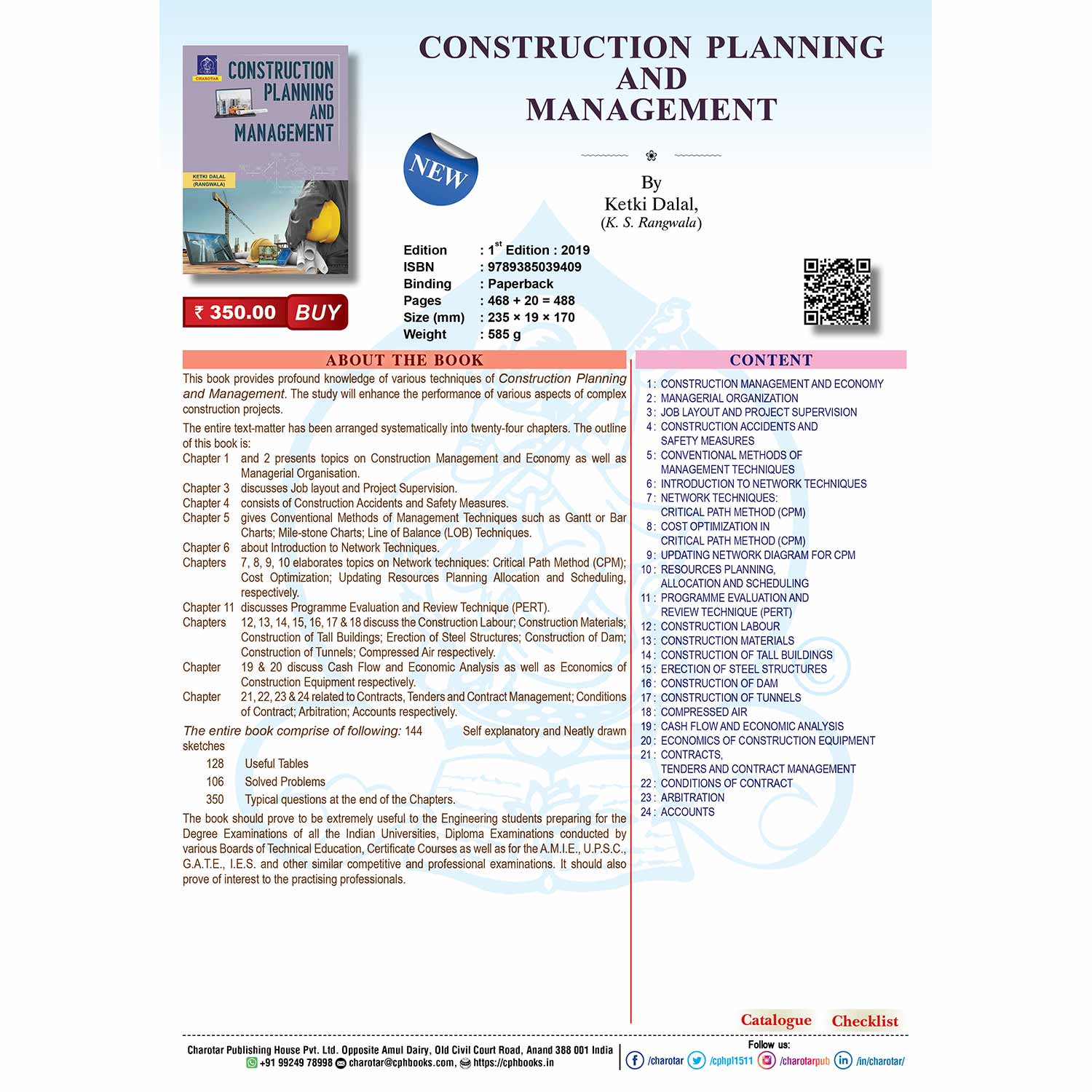
Content
1 : CONSTRUCTION MANAGEMENT AND ECONOMY
2 : MANAGERIAL ORGANIZATION
3 : JOB LAYOUT AND PROJECT SUPERVISION
4 : CONSTRUCTION ACCIDENTS AND SAFETY MEASURES
5 : CONVENTIONAL METHODS OF MANAGEMENT TECHNIQUE
6 : INTRODUCTION TO NETWORK TECHNIQUES
7 : NETWORK TECHNIQUES: CRITICAL PATH METHOD (CPM)
8 : COST OPTIMIZATION IN CRITICAL PATH METHOD (CPM)
9 : UPDATING NETWORK DIAGRAM FOR CPM
10 : RESOURCES PLANNING ALLOCATION AND SCHEDULING
11 : PROGRAMME EVALUATION AND REVIEW TECHNIQUE (PERT)
12 : CONSTRUCTION LABOUR
13 : CONSTRUCTION MATERIALS
14 : CONSTRUCTION OF TALL BUILDINGS
15 : ERECTION OF STEEL STRUCTURES
16 : CONSTRUCTION OF DAM
17 : CONSTRUCTION OF TUNNELS
18 : COMPRESSED AIR
19 : CASH FLOW AND ECONOMIC ANALYSIS
20 : ECONOMICS OF CONSTRUCTION EQUIPMENT
21 : CONTRACTS,TENDERS AND CONTRACT MANAGEMENT
22 : CONDITIONS OF CONTRACT
23 : ARBITRATION
24 : ACCOUNTS
Details Contain
[vc_row][vc_column][vc_tta_tabs][vc_tta_section title=”Page 1″ tab_id=”1584079012363-c3ba3c17-310d”][vc_column_text]
CHAPTER 1 CONSTRUCTION MANAGEMENT AND ECONOMY
1-1. General
1-2. Need for construction management
1-3. Scope of construction management
1-4. Aspect of construction management
1-5. PHASES of project or construction management
1-6. Engineer and construction economy
1-7. Contractor and construction economy
1-8. Construction cost
1-9. Cost control records
1-10. Cost index or price index
1-11. Construction cost control
1-12. Planning the project
1-13. Financing the project
1-14. Project Management Triangle
1-15. Project management activities
1-16. Stages in construction
1-17. Work breakdown structure
Questions 1
CHAPTER 2 MANAGERIAL ORGANIZATION
2-1. General
2-2. Levels of management
2-3. Functions of management
2-4. Qualities of a good entrepreneur
2-5. Construction project Manager
2-6. Characteristics of a good manager
2-7. Qualifications of an administrator
2-8. Conditions essential for carrying on business
2-9. Meaning of organization
2-10. Forms of business organization
2-11. Principles of organization
2-12. Systems of staff organization
2-13. Organization of a construction company
2-14. Office management
2-15. Personnel management
2-16. Office discipline
Questions 2
CHAPTER 3 JOB LAYOUT AND PROJECT SUPERVISION
3-1. Job layout
3-2. General principles for Job layout
3-3. Factors governing Job layout
3-4. Advantages of Job layout
3-5. Preparation of Job layout
3-6. Project supervision
3-7. Project control
3-8. Project evaluation
3-9. Construction camp
Questions 3
CHAPTER 4 CONSTRUCTION ACCIDENTS AND SAFETY MEASURES
4-1. General
4-2. Importance of Safety in Construction Projects
4-3. Causes of construction accidents
[/vc_column_text][/vc_tta_section][vc_tta_section title=”Page 2″ tab_id=”1584079014385-9424c98e-f515″][vc_column_text]
4-4. Classification of construction accidents
4-5. Injury-frequency rate
4-6. Injury-severity rate
4-7. Injury-index
4-8. Equivalent time charge
4-9. Compensation insurance
4-10. Accident costs
4-11. Safety programme in construction projects
4-12. Rules for preventing construction accidents
4-13. Safety Precautions for Different Items of Construction
4-13-1. Safety Precautions For Foundation and Excavation
4-13-2. Safety Precautions For Brickwork
4-13-3. Safety Precautions For Concrete Work
4-13-4. Safety Precautions for Concrete Work in Cold Weather
4-13-5. Safety Precautions for Concrete Work in Hot Weather
4-13-6. Safety Precautions for Form Work
4-13-7. Safety Precautions for Scaffolding
4-13-8. Safety Precautions for Shoring
4-13-9. Safety Precautions for Underpinning
4-13-10. Safety Precautions for Steel Structures
4-13-11. Safety Precautions for the Construction of Multi-Storeyed Buildings
4-13-12. Safety Precautions for hot Bituminous Work
4-13-13. Safety Precautions for Demolition work
4-13-14. Safety Precautions for Storage of Materials
4-13-15. Safety Precautions for Tunnel Construction
Questions 4
CHAPTER 5 CONVENTIONAL METHODS OF MANAGEMENT TECHNIQUES
5-1. General
5-2. CONVENTIONAL METHODS
5-3. Gantt or Bar charts
5-4. Mile-Stone Charts
5-5. Line of Balance (Lob) Technique
Questions 5
CHAPTER 6 NTRODUCTION TO NETWORK TECHNIQUES
6-1. General
6-2. Features of network planning
6-3. Elements of Network Diagram
6-4. Rules for Preparing Network Diagram
Rules for network diagram
6-5. Fulkerson’s Rule for Numbering the Events
6-6. Types of Network Diagram
6-6-1. Arrow diagram or Activity-On-Arrow (AOA) diagram
6-6-2. Circle diagram or Activity-On-Node (AON) diagram
6-7. Typical problems on network diagram
Questions 6
CHAPTER 7 NETWORK TECHNIQUES: CRITICAL PATH METHOD (CPM)
7-1. General
7-2. Uses of CPM
7-3. Advantages of CPM
7-4. Application of CPM in project management
7-5. CPM for determining extension of time
7-6. Difficulties in implementation of the CPM
7-7. Activity Duration Time (t)
[/vc_column_text][/vc_tta_section][vc_tta_section title=”Page 3″ tab_id=”1584088014385-9424c98e-f515″][vc_column_text]
7-8. Earliest occurrence time (TE) for event
7-9. Latest occurrence time (TL) for event
7-10. Start and Finish Times for activity
7-11. FLOATS
7-12. Significance of floats
7-13. Critical path and scheduling
7-14. Typical problems on critical path method (CPM)
Questions 7
CHAPTER 8 COST OPTIMIZATION IN CRITICAL PATH METHOD (CPM)
8-1. GENERAL
8-2. Utility data with respect to time and cost
8-3. Project cost
8-4. Cost-time optimization
8-5. Cost slope
8-6. Cost Optimization by crashing
8-7. Time-grid diagram
8-8. Typical problems on cost optimization
Questions 8
CHAPTER 9 UPDATING NETWORK DIAGRAM FOR CPM
9-1. General
9-2. Necessity of Updating
9-3. Steps for Updating
9-4. Typical Problems on Updating Network Diagram for CPM
Question 9
CHAPTER 10 RESOURCES PLANNING, ALLOCATION AND SCHEDULING
10-1. Resources planning
10-2. Resources allocation
10-3. Resource scheduling
10-4. Typical problems on resources planning, allocation and scheduling
Questions 10
CHAPTER 11 PROGRAMME EVALUATION AND REVIEW TECHNIQUE (PERT)
11-1. Programme Evaluation and
Review Technique (PERT)
11-2. Terminology Used in PERT
11-3. Percentage of probability
11-4. Implementing PERT
11-5. PERT network scheduling
11-6. Slacks of events
11-7. Negative slack and negative float
11-8. Typical problems on PERT
11-9. Selection of technique
Questions 11
CHAPTER 12 CONSTRUCTION LABOUR
12-1. General
12-2. Immobility of labour
12-3. Theories of wages
12-4. Nominal wages and real wages
12-5. Psychic income
12-6. Systems of wage payments
12-7. Incentive plans
12-7-1. Group incentive plans
12-8. Payment by result
12-9. Profit-sharing
12-10. Morale Measurement of moral
12-11. Trade unions
12-12. Labour welfare
[/vc_column_text][/vc_tta_section][vc_tta_section title=”Page 4″ tab_id=”1584014014385-9424c98e-f515″][vc_column_text]
12-13. Indian labour
Questions 12
CHAPTER 13 CONSTRUCTION MATERIALS
13-1. General
13-2. Types of materials
13-3. Storage of materials
13-4. Stores
13-5. Purchasing department
13-6. Store keeping
13-7. Stock control
13-8. Stages of material management
13-9. Inventory control
13-10. Disposal of surplus materials
Questions 13
CHAPTER 14 CONSTRUCTION OF TALL BUILDINGS
14-1. General
14-2. Need of tall buildings
14-3. Advantages and disadvantages of tall buildings
14-4. Essential amenities in tall buildings
14-5. Framed structures
14-6. Placing concrete in cold weather
14-7. Placing concrete in hot weather
14-8. Points to be observed while supervising R.C.C. work
14-9. Quality control of concrete
14-10. Repairs and maintenance of concrete structure
14-11. Preparation of concrete surface for repairs
14-12. Problems of tall buildings
14-13. Precautions to be taken during the construction of
multi-storeyed buildings
Questions 14
CHAPTER 15 ERECTION OF STEEL STRUCTURES
15-1. General
15-2. Equipments required for erection of steel structures
15-3. Joints
15-4. Cost of erection of steel structures
15-5. Erection procedures of steel structures
15-6. Safety rules during erection of steel structures 45
Questions 15
CHAPTER 16 CONSTRUCTION OF DAM
16-1. General
16-2. Types of dams
16-3. Rigid dams (masonry dams, concrete dams etc.)
16-4. Non-rigid dams (earth dams or embankment dems)
16-5. Miscellaneous dams
Questions 16
CHAPTER 17 CONSTRUCTION OF TUNNELS
17-1. Definition
17-2. Advantages of tunnelling
17-3. Economics of tunnelling
17-4. Selection of route
17-5. Tunnel surveying
17-6. Alignment of a tunnel
17-7. Setting out of tunnel
[/vc_column_text][/vc_tta_section][vc_tta_section title=”Page 5″ tab_id=”1584014014385-4484c98e-f515″][vc_column_text]
17-8. Tunnelling through rock
17-9. Tunnelling through soft ground
17-9-1. Forepoling method
17-9-2. Needle beam method
17-9-3. Five-piece set method or american method
17-9-4. Liner plates method
17-9-5. Other methods
17-10. Methods of tunnelling through sub-aqueous strata
17-11. Drainage of tunnels
17-12. Ventilation of tunnels
17-13. Lighting
17-14. Shafts
17-15. Mucking
17-16. Hauling
17-17. Lining of tunnels
17-18. Size and shape of tunnels
Questions 17
CHAPTER 18 COMPRESSED AIR
18-1. General
18-2. Uses of compressed air
18-3. Some definitions
18-4. Gas laws
18-5. Size of pipes
18-6. Cost of compressed air
18-7. Compressed air plant
Questions 18
CHAPTER 19 CASH FLOW AND ECONOMIC ANALYSIS
19-1. General
19-2. Cash Flow Analysis
19-3. Objects Of Cash Flow Analysis
19-4. Cash Flow Management in Construction Projects
19-5. Improvement In Project Cash Flow
19-6. Cash flow Diagram
19-7. S-Curve
19-8. Project Life Cycle
19-9. Principles of Accounting
Following are ten main basic principles of accounting
19-10. Time Value of Money
19-11. Tools of management control
19-12. Economics of engineering structures
19-13. Financial analysis
19-14. Discounted cash flow
Questions 19
CHAPTER 20 ECONOMICS OF CONSTRUCTION EQUIPMENT
20-1. General
20-2. Classification of equipment
20-3. Selection of equipment
20-4. Standard equipment
20-5. Special equipment
20-6. Owning and operating Cost of equipment
20-6-1. Depreciation
20-6-2. Investment charges
20-6-3. Maintenance and repairs
20-6-4. Operation cost
20-7. Economic life and replacement policy
20-8. Sources of equipment
Questions 20
[/vc_column_text][/vc_tta_section][vc_tta_section title=”Page 6″ tab_id=”2484014014385-4484c98e-f515″][vc_column_text]
CHAPTER 21 CONTRACTS, TENDERS AND CONTRACT MANAGEMENT
21-1. Definitions
21-2. Essential requirements or elements of a valid contract
21-3. Trade usages
21-4. Forms of contract
21-4-1. Lump-sum contracts
21-4-2. Unit-price or item-rate contracts
21-4-3. Cost-plus or percentage contracts
21-4-4. Basic price contracts
21-5. Types of contracts
21-6. Termination of contracts
21-7. Contract documents
21-8. Qualification of contractors
21-8-1. Post-qualification of contractors
21-8-2. Pre-qualification of contractors
21-8-3. Independent contractor
21-8-4. Irresponsible contractor
21-9. Responsibilities of different agencies
21-10. Contract between owner and engineer
21-11. Work executed without a contract
21-12. Contract Management
21-12-1. Contract Management Process
21-12-2. Importance of Contract Management
21-13. Meaning of tender
21-14. Classification of tenders
21-15. Tender notice
Specimen tender notice
21-16. Advertisement of tender
21-17. Tender form
21-18. Mode of submission of tender
21-19. Opening of tenders
21-20. Scrutiny of tenders
21-21. Acceptance of tender
21-22. Revocation of tender
21-23. Unbalanced tender
21-24. E-tendering
21-25. Liquidated damages
21-26. Mobilization fund
21-27. Direct and indirect costs
Questions 21
CHAPTER 22 CONDITIONS OF CONTRACT
22-1. Definition
22-2. Object
22-3. Importance
22-4. Peculiarities
22-5. General provisions
22-6. Typical clauses of the conditions of contract
22-7. Escalation clause
22-8. Conditions of contract in outlines
Questions 22
CHAPTER 23 ARBITRATION
23-1. General
23-2. Definition
23-3. Arbitration and conciliation act 1996
23-4. Construction disputes and arbitration
23-5. Evidence and documents in construction industry
23-6. Matters for reference to arbitration
23-7. Kinds of arbitration
[/vc_column_text][/vc_tta_section][vc_tta_section title=”Page 7″ tab_id=”1584222014385-4484c98e-f515″][vc_column_text]
23-8. Arbitrator
23-9. Appointment Of Arbitrators
23-10. Powers of an arbitrator
23-11. Disabilities of an arbitrator
23-12. Arbitration agreement
23-13. Revocation of arbitration agreement/denial of reference to arbitration
23-14. Termination of arbitration proceedings
23-15. Process of arbitration
23-16. Award by an arbitrator
23-17. Conditions favourable for arbitration
23-18. Advantages of arbitration
23-19. Quick Dispute Resolution (QDR) methodology
23-20. Alternative Dispute Resolution (Adr)
Under the Code Of Civil Procedure
Questions 23
CHAPTER 24 ACCOUNTS
24-1. General
24-2. Stores
24-3. Difference between accounts of ‘Stock’ and ‘Tools and Plants’
24-4. Issue notes
24-5. Note Book
24-6. Vouchers
24-7. Hand receipts
24-8. Unstamped receipts
24-9. Receipt of money
24-10. Treasury Challan
24-11. Cash Book
24-12. Credit Note
24-13. Work-abstract
24-14. Register of works
24-15. Appropriation and re-appropriation
24-16. Materials at site accounts
24-17. Capital works and repair works
24-18. Administrative approval and technical sanction
24-19. Measurement book (m.b.)
24-20. Muster roll
24-21. Completion report
24-22. Imprest
24-23. Daily report
24-24. Deposit works
24-25. Record of Bills
24-26. Advance payment and secured advance payment
24-27. Piece-work system of payment
24-28. Inventory
24-29. Work-slip and work-abstract
24-30. Site Order Book
24-31. Methods of Execution of Work in P.W.D.
24-32. Selection of Mode of Execution of Work in P.w.d.
24-33. Difference Between Department Execution and Contract
System
Questions 24
[/vc_column_text][/vc_tta_section][/vc_tta_tabs][/vc_column][/vc_row]
Only logged in customers who have purchased this product may leave a review.

Reviews
There are no reviews yet.