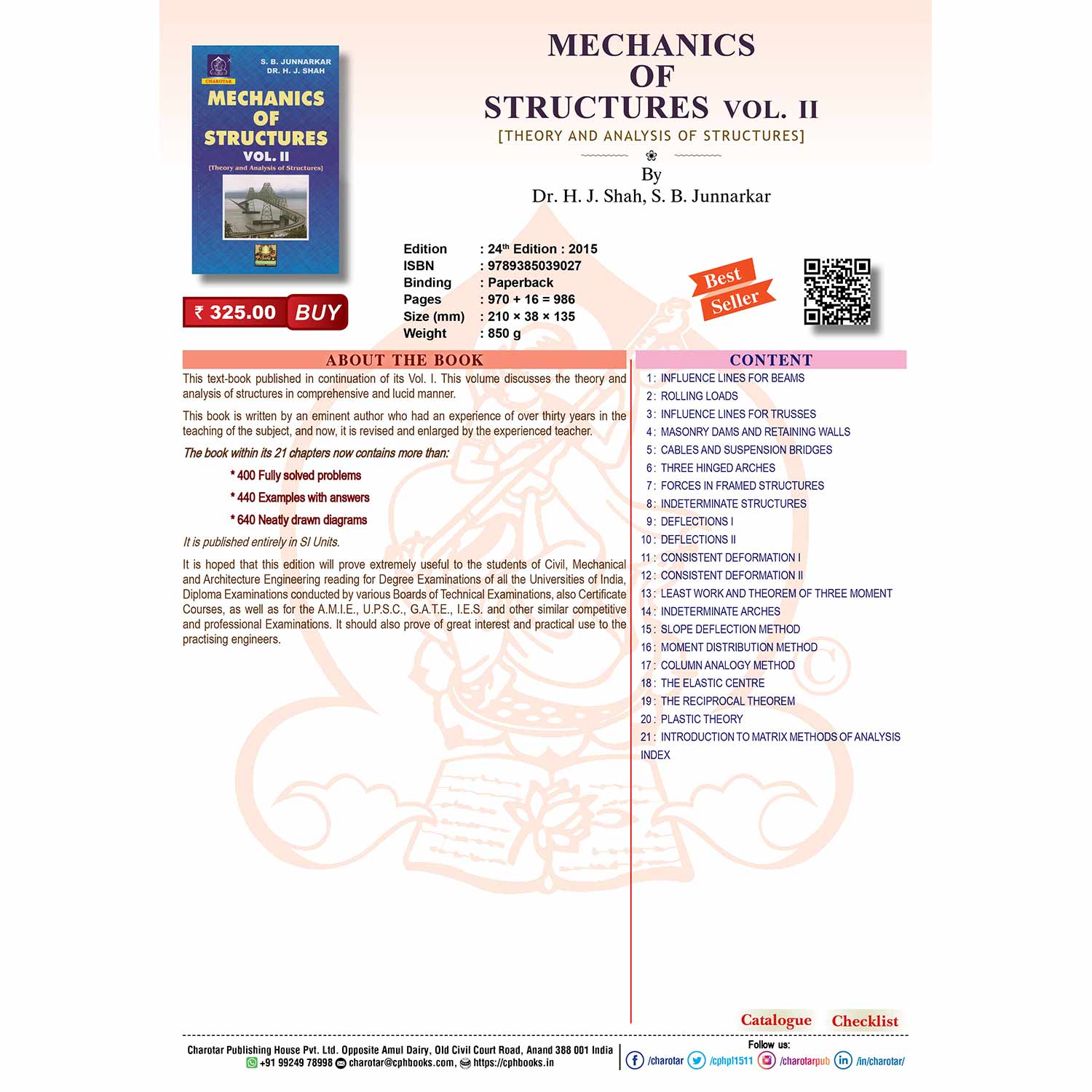
Content
1 : INFLUENCE LINES FOR BEAMS
2 : ROLLING LOADS
3 : INFLUENCE LINES FOR TRUSSES
4 : MASONRY DAMS AND RETAINING WALLS
5 : CABLES AND SUSPENSION BRIDGES
6 : THREE HINGED ARCHES
7 : FORCES IN FRAMED STRUCTURES
8 : INDETERMINATE STRUCTURES
9 : DEFLECTIONS I
10 : DEFLECTIONS II
11 : CONSISTENT DEFORMATION I
12 : CONSISTENT DEFORMATION II
13 : LEAST WORK AND THEOREM OF THREE MOMENT
14 : INDETERMINATE ARCHES
15 : SLOPE DEFLECTION METHOD
16 : MOMENT DISTRIBUTION METHOD
17 : COLUMN ANALOGY METHOD
18 : THE ELASTIC CENTRE
19 : THE RECIPROCAL THEOREM
20 : PLASTIC THEORY
21 : INTRODUCTION TO MATRIX METHODS OF ANALYSIS
INDEX
Details Content
[vc_row][vc_column][vc_tta_tabs][vc_tta_section title=”Page 1″ tab_id=”1584091657941-5ae8243a-96b1″][vc_column_text]
Chapter 1 INFLUENCE LINES FOR BEAMS
1-1. Introductory
1-2. Influence line
1-3. Influence lines for simple beam reactions
1-4. Influence lines for simple beam shears
1-5. Influence lines for simple beam moments
1-6. Uses of influence lines
1-7. Influence lines for girders with floor joists
1-8. Compound beams
1-9. Closure
Examples I
Chapter 2 ROLLING LOADS
2-1. Rolling loads
2-2. Maximum shear in a beam supporting uniformly distributed
loads
2-3. Maximum bending moments at sections in beams supporting
uniformly distributed load
2-4. Maximum shear at sections in a beam supporting two
concentrated loads
2-5. Maximum moment at sections in a beam supporting two
concentrated loads
2-6. Maximum end shear in a beam supporting a series of moving
concentrated loads
2-7. Maximum shear at sections of beams supporting a series of
moving concentrated loads
2-8. Maximum moment at a section in a beam supporting a series
of moving concentrated loads
2-9. Absolute maximum moment in a beam supporting a series of
moving concentrated loads
2-10. Maximum S.F. and maximum B.M. diagrams
2-11. Equivalent uniformly distributed load
2-12. Combined dead load and moving load S.F. diagrams: Focal
length
Examples II
Chapter 3 INFLUENCE LINES FOR TRUSSES
3-1. Introductory
3-2. Bridge floor system
3-3. Influence lines for truss reactions
3-4. Influence lines for member forces
3-5. Determination of maximum forces
3-6. Counters in bridge trusses
3-7. Influence lines for non-parallel chord trusses
Examples III
Chapter 4 MASONRY DAMS AND RETAINING WALLS
4-1. Water pressure
4-2. Conditions of stability
4-3. The minimum bottom width for stability
4-4. Trapezoidal section with a sloping water face
4-5. Other forms of section
4-6. Resultant thrust outside the middle third
4-7. Retaining walls
4-8. The inclined plane
4-9. Rankine’s theory of earth pressure
4-10. Retaining wall of trapezoidal section, earth level with the top
of the wall
4-11. Surcharged retaining wall
4-12. Graphical methods
4-13. Wedge theory of earth pressure: Rebhann – Häseler’s method
4-14. Minimum depth of foundation
Examples IV
Chapter 5 CABLES AND SUSPENSION BRIDGES
5-1. Equilibrium of a light suspended cord under a given system
of loading
5-2. Shape of the cord
5-3. Light suspension bridges
5-4. Cable supports at different levels
5-5. Anchor cables
5-6. Temperature stresses
5-7. The Catenary
5-8. Moving loads on suspension bridges
5-9. Suspension bridge with three hinged stiffening girders
5-10. Two hinged stiffening girder
5-11. Temperature stresses in stiffening girder
Examples V
Chapter 6 THREE HINGED ARCHES
6-1. Metal arches
6-2. Linear arch or line of thrust
6-3. Bending moments: Eddy’s theorem
6-4. Three hinged arch
6-5. Braced three hinged arch
6-6. Graphical methods
6-7. Moving loads on three hinged arches
6-8. Temperature effects
Examples VI
Chapter 7 FORCES IN FRAMED STRUCTURES
7-1. Framed structures with sub-divided panels
7-2. Pratt truss with parallel chords and sub-struts: through type
7-3. Pratt truss with parallel chords and sub-ties: deck type
7-4. Pratt truss with non-parallel chords
7-5. Warren truss with sub-divided panels
7-6. Rolling loads: Influence lines
7-7. Pratt truss with inclined chord: Influence lines
7-8. The Wichert Truss
7-9. Dynamical loads on bridges: Impact allowance
7-10. Wind pressure
7-11. Working stresses
Chapter 8 INDETERMINATE STRUCTURES
8-1. Determinateness of the structure
8-2. Use of indeterminate structures
8-3. Methods of analysis
8-4. Approximate analysis of indeterminate structures
8-5. Truss with two hinges
8-6. Trusses with two diagonals in each panel
8-7. Industrial frame
8-8. Building frames subjected to gravity loads
8-9. Building frames subjected to lateral loads
8-10. The portal method
8-11. The cantilever method
8-12. Vierendeel truss
Examples VIII
Chapter 9 DEFLECTIONS I
9-1. Introductory
9-2. Moment area method
9-3. Method of elastic weights
9-4. Conjugate beam method
9-5. Virtual work — unit load method: Basic formula
9-6. The unit load method applied to deflections of beams and frames
9-7. The unit load method applied to beam rotations
9-8. Strain energy
9-9. Castigliano’s first theorem
9-10. Castigliano’s first theorem applied to beam deflections and rotations
Examples IX
[/vc_column_text][/vc_tta_section][vc_tta_section title=”Page 2″ tab_id=”1584091657965-f537d4c6-1fea”][vc_column_text]
Chapter 10 DEFLECTIONS II
DEFLECTION OF FRAMED STRUCTURES
10-1. The unit load method applied to deflections of trusses
10-2. The first theorem of Castigliano
10-3. Graphical methods: Williot-Mohr diagrams
10-4. Maxwell’s theorem of reciprocal deflections
10-5. Influence line for deflection
Examples X
Chapter 11 CONSISTENT DEFORMATION I
11-1. The method of consistent deformation
11-2. Beams with one redundant
11-3. Beams with two or more redundants
11-4. Continuous beams
11-5. Fixed beams
11-6. Support settlement
11-7. Influence lines for indeterminate beams
11-8. Qualitative influence lines
Examples XI
Chapter 12 CONSISTENT DEFORMATION II
ANALYSIS OF INDETERMINATE TRUSSES
12-1. Externally redundant trusses
12-2. Internally redundant trusses
12-3. Externally and internally redundant trusses
12-4. Secondary forces
12-5. Influence lines for statically indeterminate trusses
Examples XII
Chapter 13 LEAST WORK AND THEOREM OF THREE
MOMENT
13-1. The second theorem of Castigliano: Principle of least work or
minimum strain-energy
13-2. Portal frames
13-3. The three moment theorem
13-4. Support settlement
Examples XIII
Chapter 14 INDETERMINATE ARCHES
14-1. Bending of a curved bar
14-2. Two-hinged arch
14-3. Moving loads on two-hinged arches
14-4. Temperature stresses
14-5. Fixed arch
14-6. Temperature stresses
14-7. Two-hinged arch: Strain energy method
14-8. Suspension cable with a two-hinged stiffening girder
14-9. The masonry arch
14-10. Fuller’s test for stability of an arch
Examples XIV
Chapter 15 SLOPE DEFLECTION METHOD
15-1. Introduction
15-2. Sign conventions
15-3. Development of slope deflection equations: Assumptions
15-4. Modification for simple ends
15-5. Frames with no side-sway
15-6. Frames with side-sway
Examples XV
Chapter 16 MOMENT DISTRIBUTION METHOD
16-1. Introductory
16-2. Description of the method
16-3. Carry-over moment
16-4. Distribution factors
16-5. Definitions
16-6. Sign conventions
16-7. Fixed end moments
16-8. Application of method
16-9. Modification of stiffness for simple ends
16-10. Shear and moment diagrams
16-11. Overhanging beams
MOMENT DISTRIBUTION FOR FRAMES
16-12. Frames with side-sway prevented
16-13. Frames with side-sway
16-14. Portal frames with inclined members
Examples XVI
Chapter 17 COLUMN ANALOGY METHOD
17-1. Introductory
17-2. The method
17-3. Stiffness and carry-over factor
17-4. Maxwell’s reciprocal law
17-5. Analysis of frames by column analogy method
17-6. Analysis of gable frames
17-7. Analysis of unsymmetrical frames
Examples XVII
Chapter 18 THE ELASTIC CENTRE
18-1. Introductory
18-2. The fixed-base portal frame
18-3. The elastic centre
18-4. Fixed arches
18-5. Circular arch
18-6. Two-hinged arches
Examples XVIII
Chapter 19 THE RECIPROCAL THEOREM
19-1. Introductory
19-2. The reciprocal theorem
19-3. Influence coefficients
19-4. Proof
19-5. Models
Examples XIX
Chapter 20 PLASTIC THEORY
20-1. Limit design: Load factor
20-2. Plastic bending: Plastic hinge: Shape factor
20-3. Simply supported beams
20-4. Propped cantilevers
20-5. Encastré beams
20-6. Design of beams
20-7. Continuous beams
20-8. Portal frames
20-9. Analytical methods: Virtual work
20-10. Combined bending and axial load
Examples XX
Chapter 21 INTRODUCTION TO MATRIX METHODS OF
ANALYSIS
21-1. Actions and displacements
21-2. Equilibrium and compatibility
21-3. Static and kinematic indeterminacy
21-4. Structural mobilities
21-5. Flexibility and stiffness
21-6. General case
21-7. Closure
Index
[/vc_column_text][/vc_tta_section][/vc_tta_tabs][/vc_column][/vc_row]
Only logged in customers who have purchased this product may leave a review.











Reviews
There are no reviews yet.