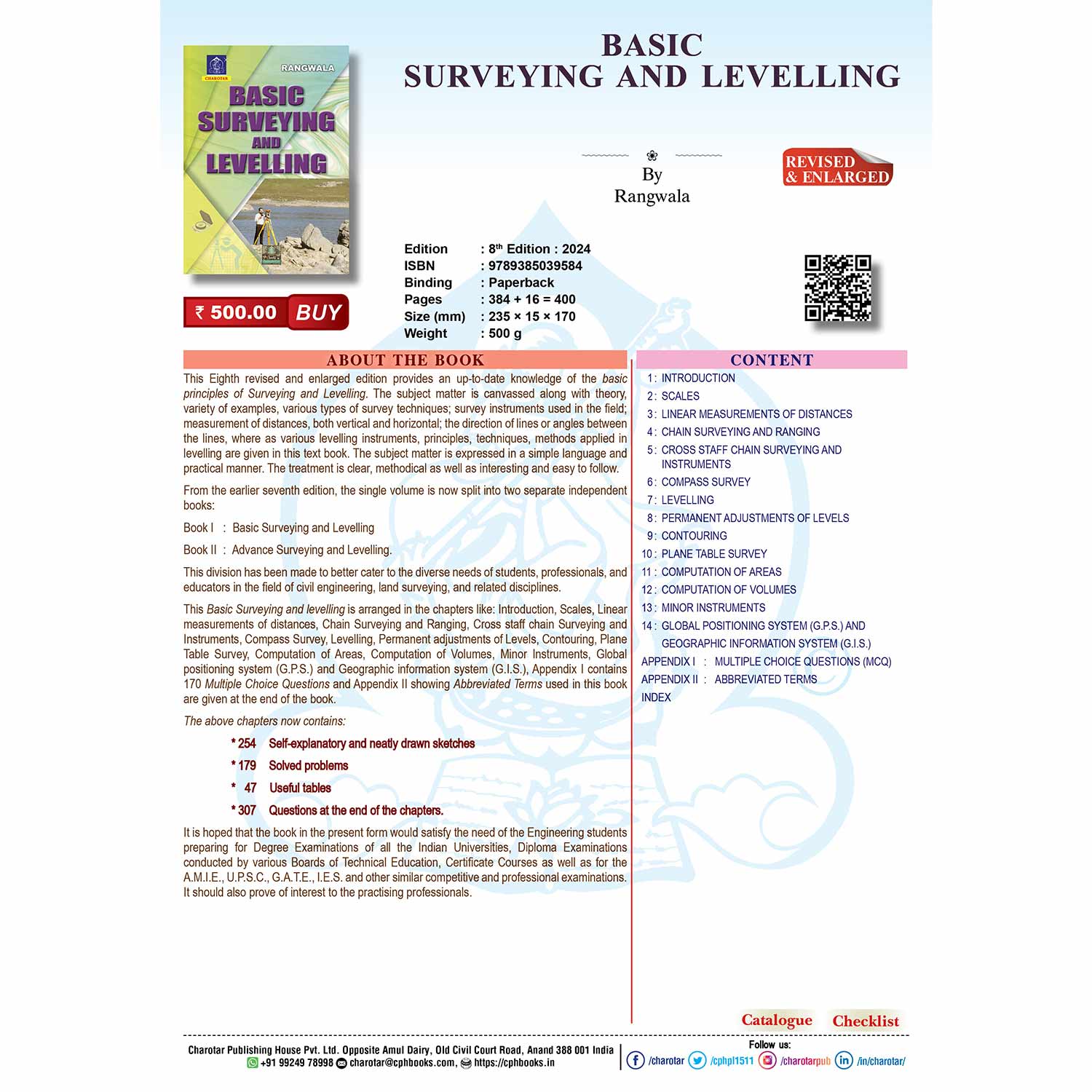
Content
1 : INTRODUCTION
2 : SCALES
3 : LINEAR MEASUREMENTS OF DISTANCES
4 : CHAIN SURVEYING AND RANGING
5 : CROSS STAFF CHAIN SURVEYING AND
INSTRUMENTS
6 : COMPASS SURVEY
7 : LEVELLING
8 : CONTOURING
9 : PLANE TABLE SURVEY
10 : COMPUTATION OF AREAS
11 : COMPUTATION OF VOLUMES
12 : MINOR INSTRUMENTS
13 : THEODOLITE
14 : PERMANENT ADJUSTMENTS OF LEVELS
15 : TACHEOMETRIC SURVEYING
16 : CIRCULAR CURVES
17 : TRANSITION CURVES
18 : VERTICAL CURVES
19 : FIELD ASTRONOMY
20 : THEORY OF ERRORS
21 : SETTING OUT WORKS
22 : HYDROGRAPHIC SURVEYING
23 : PHOTOGRAPHIC SURVEYING
24 : MODERN TECHNIQUES OF SURVEYING
APPENDIX I : QUESTION BANK AND SOLVED
PROBLEMS
APPENDIX II : MULTIPLE CHOICE QUESTIONS
APPENDIX III : ABBREVIATED TERMS
INDEX
Details Content
[vc_row][vc_column][vc_tta_tabs][vc_tta_section title=”Page 1″ tab_id=”1584007646842-2eb4301a-8f77″][vc_column_text]
Chapter 1 INTRODUCTION
1-1. General
1-2. Object of survey
1-3. Purposes of survey
1-4. Classification of surveys
1-4-1. Engineering surveys
1-4-2. Geodetic surveys
1-4-3. Plane surveys
1-4-4. Miscellaneous surveys
1-5. Principles of surveying
1-6. Uses of survey
1-7. Measurements and their units
1-8. Roll of Surveyor
1-9. Precision and accuracy in surveying
QUESTIONS 1
Chapter 2 SCALES
2-1. General
2-2. Requirements of a scale
2-3. Classification of scales
2-3-1. Plain scale
2-3-2. Diagonal scale
2-3-3. Vernier scale
2-3-4. Miscellaneous scales
2-4. Plans and maps
2-5. Scale for survey maps and plans
2-6. Correction due to use of wrong scale
QUESTIONS 2
Chapter 3 LINEAR MEASUREMENTS OF DISTANCES
3-1. General
3-2. Direct methods of linear measurements
3-2-1. Direct methods without instruments
3-2-2. Direct methods with instruments
3-3. Types of chains
3-4. Testing and adjusting of chain
3-5. Instruments for marking stations
3-6. Types of tapes
3-7. Tape corrections
QUESTIONS
Chapter 4 CHAIN SURVEYING AND RANGING
4-1. General
4-2. Principle of chain survey
4-3. Survey stations
4-4. Survey lines
4-5. Offsets
4-6. Ranging
4-7. Types of ranging
4-7-1. Direct ranging
4-7-2. Indirect ranging
4-8. Chaining on plain ground
4-9. Points to be observed during chaining
4-10. Chaining on sloping ground
4-10-1.Direct method of chaining
4-10-2.Indirect method of chaining
4-11. Errors in ordinary chaining
4-11-1.Compensating errors
4-11-2.Cumulative errors
4-12. Degree of accuracy in chaining work
4-13. Field book
4-14. Instruments required in chain survey
4-15. Procedure for carrying out chain survey
4-16. Plotting work with conventional signs
QUESTIONS 4
Chapter 5 CROSS STAFF CHAIN SURVEYING AND
INSTRUMENTS
5-1. General
5-2. Purpose
5-3. Basic principle
5-4. Instruments for setting out perpendiculars
5-4-1. Chain or tape
5-4-2. Cross-staff
5-4-3. Optical square
5-5. Cross-staff survey
5-6. Obstacles in chaining
5-6-1. Chaining free but vision obstructed
5-6-2. Chaining obstructed but vision free
5-6-3. Chaining and vision both obstructed
QUESTIONS 5
Chapter 6 COMPASS SURVEY
6-1. General
6-2. Traversing and triangulation
6-3. Methods of measuring direction
6-4. Magnetic needle
6-5. Pivot
6-6. Compass
6-7. Tripods
6-8. Bearings
6-9. Magnetic declination
6-10. Classification of declination
6-11. Methods of designation
6-12. Fore bearing and back bearing
6-13. Included angles from bearings
6-14. Local attraction
6-15. Chain and compass survey
6-16. Plotting of compass survey
6-17. Closing error
6-18. Errors in compass survey
6-19. Precautions in using the compass
6-20. Accuracy and precision
6-21. Limits of precision
QUESTIONS 6
Chapter 7 LEVELLING
7-1. General
7-2. Definitions of some common terms in levelling
7-3. Methods of levelling
7-3-1. Direct levelling
7-3-2. Indirect levelling
7-4. Principles of levelling
7-5. Instruments for levelling
7-6. Types of levels
7-7. Levelling staff
7-8. Essential parts of a level
7-9. Parallax and focussing
7-10. Defects of a single lens
7-11. Parts of a telescope
7-12. Optical characteristics of telescope
7-13. Accessories to a level
7-14. Bench marks
7-15. Temporary adjustments of levels
7-16. Entering the staff readings
7-17. Reduction of levels
7-18. Difficulties in levelling
7-19. Curvature and refraction
7-20. Errors in levelling
7-21. Precision of levelling
QUESTIONS 7
[/vc_column_text][/vc_tta_section][vc_tta_section title=”Page 2″ tab_id=”1584007587948-d46c9a99-7582″][vc_column_text]
Chapter 8 CONTOURING
8-1. General
8-2. Contour lines
8-3. Contour interval
8-4. Horizontal equivalent
8-5. Characteristics of contours
8-6. Location of contours
8-7. Interpolation of contours
8-8. Contour drawing
8-9. Contour gradient
8-10. Uses of contours
QUESTIONS 8
Chapter 9 PLANE TABLE SURVEY
9-1. General
9-2. Instruments required for plane table survey
9-3. Accessories required for plane table survey
9-4. Temporary adjustments of plane table
9-5. Methods of plane table survey
9-6. Two-point and three-point problems
9-6-1. Two-point problem
9-6-2. Three-point problem
9-7. Errors in plane table survey
9-8. Advantages of plane table survey
9-9. Disadvantages of plane table survey
QUESTIONS 9
Chapter 10 COMPUTATION OF AREAS
10-1. General
10-2. Methods for the computation of areas
10-3. Geometrical figures
10-4. Measuring grids
10-5. Ordinates
10-6. Co-ordinates
10-7. Planimeter
10-8. Method of using a planimeter
10-9. Zero circle
QUESTIONS 10
Chapter 11 COMPUTATION OF VOLUMES
11-1. General
11-2. Methods for computation of volumes
11-2-1.Cross-sections
11-2-2.Spot levels
11-2-3.Study of contour plan
11-3. Prismoidal correction
11-4. Curvature correction for volumes
QUESTIONS 11
Chapter 12 MINOR INSTRUMENTS
12-2. Abney level
12-2-1.Essential parts of abney level
12-2-2.Working of abney level
12-2-3.Testing of abney level
12-3. Box sextant
12-3-1.Essential parts of box sextant
12-3-2.Principle of box sextant
12-3-3.Working of box sextant
12-3-4.Optical requirements and adjustments of box sextant
12-4. Ceylon ghat tracer
12-4-1.Essential parts of ghat tracer
12-4-2.Working of ghat tracer
12-5. De Lisle’s clinometer
12-5-1.Essential parts of De Lisle’s clinometer
12-5-2.Working of De Lisle’s clinometer
12-6. Eidograph
12-7. Foot-rule clinometer
12-7-1.Working of foot-rule clinometer
12-8. Hand level
12-8-1.Working of hand level
12-8-2.Adjustment of the hand level
12-9. Indian pattern clinometer
12-9-1.Essential parts of Indian pattern clinometer:
12-9-2.Working of Indian pattern clinometer
12-9-3.Adjustment of Indian pattern clinometer
12-10. Pantagraph
12-11. Proportional compass
12-12. Watkin’s mirror clinometer
QUESTIONS 12
Chapter 13 THEODOLITE
13-1 General
13-2 Essential parts of a transit theodolite
13-3 Definitions and terms used for theodolite work
13-4. Micrometer theodolites
13-5. Temporary adjustments of theodolite
13-6. Measurement of horizontal angles
13-7. Measurement of vertical angles
13-8. Miscellaneous operations with theodolite
13-9. Theodolite traverse
13-10. Locating details in theodolite traverse
13-11. Degree of accuracy in theodolite traversing
13-12. Plotting of theodolite traverse
13-13. Closing error
13-14. Angular error
13-15. Adjustment of bearings
13-16. Balancing the traverse
13-17. Traverse table
13-18. Errors in theodolite work
13-19. Fundamental lines and desired relations
13-20. Permanent adjustments of theodolite
13-21. Uses of theodolite
13-22. Typical problems on theodolite
13-23. Modern theodolites
QUESTIONS 13
Chapter 14 PERMANENT ADJUSTMENTS OF LEVELS
14-1. General
14-2. Fundamental axes of the levelling instruments
14-3. Principle of reversibility
14-4. Precautions to be taken during the permanent adjustments
14-5. Adjustments of dumpy level
14-6. Adjustments of Y-level
14-7. Adjustments of Cooke’s reversible level
14-8. Adjustments of Cushing’s level
14-9. Adjustments of tilting level
QUESTIONS 14
Chapter 15 TACHEOMETRIC SURVEYING
15-1. General
15-2. Instruments
15-3. Uses of tacheometry
15-4. Systems of tacheometric measurements
15-5. Stadia method
15-6. Subtense method
15-7. Tangential method
QUESTIONS 15
[/vc_column_text][/vc_tta_section][vc_tta_section title=”Page 3″ tab_id=”1584007587925-3d338873-53f6″][vc_column_text]
Chapter 16 CIRCULAR CURVES
16-1. General
16-2. Classification of circular curves
16-3. Simple curves
16-4. Elements of simple curve
16-5. Location of tangents
16-6. Location of tangent points
16-7. Peg Interval
16-8. Normal chords and sub-chords
16-9. Setting out simple curves
16-9-1.Linear methods
16-9-2.Angular methods
16-10. Special problems in simple curves
16-11. Compound curves
16-12. Setting out compound curves
16-13. Reverse or serpentine curves
QUESTIONS 16
Chapter 17 TRANSITION CURVES
17-1. General
17-2. Requirements of transition curve
17-3. Composite curve
17-4. Super-elevation
17-5. Centrifugal ratio
17-6. Length of transition curve
17-7. Ideal transition curve
17-8. Cartesian co-ordinates of the points
17-9. Calculation of deflection angles
17-10. Modifications of ideal transition curve
17-11. Characteristics of a transition curve
17-12. Lemniscate transition curve
17-13. Comparison of transition curves
QUESTIONS 17
Chapter 18 VERTICAL CURVES
18-1. General
18-2. Grade or gradient
18-3. Rate of change of gradient
18-4. Types of vertical curves
18-5. Equation of vertical curve
18-6. Length of vertical curve
18-7. Sight distance of vertical curve at summit
18-8. Sight distance of vertical curve at sag
18-9. Vertical curve passing through a fixed point
18-10. Setting out vertical curves
18-11. Typical problems on vertical curves
QUESTIONS 18
Chapter 19 FIELD ASTRONOMY
19-1. General
19-2. Some astronomical terms
19-3. Terrestrial latitude and longitude
19-4. Parallel of latitude
19-5. Nautical mile
19-6. Spherical trigonometry
19-7. Spherical triangle
19-8. Some useful data
19-9. Astronomical triangle
19-10. Star at elongation
19-11. Star at prime vertical
19-12. Star at culmination or transit
19-13. Circumpolar stars
19-14. Star at horizon
19-15. Relationships between co-ordinates
19-16. Time
QUESTIONS 19
Chapter 20 THEORY OF ERRORS
20-1. General
20-2. Accuracy and precision
20-3. Types of errors
20-4. Some definitions
20-5. Laws of accidental errors
20-6. Probability curve
20-7. Most probable value
20-8. Average error and maximum error
20-9. Mean square error
20-10. Method of least squares
20-11. Laws of weights
20-12. Rules for giving weights to the field observations
20-13. Distribution of error to the field observations
QUESTIONS 20
Chapter 21 SETTING OUT WORKS
21-1. General
21-2. General considerations
21-3. Control stations
21-4. Horizontal control
21-5. Vertical control
21-6. Setting out of structure
21-7. Setting out of important structures
QUESTIONS 21
Chapter 22 HYDROGRAPHIC SURVEYING
22-1. General
22-2. Requirements of hydrographic survey
22-3. Shore line survey
22-4. Soundings
22-5. Location of soundings
22-6. Reduction of soundings
22-7. Tides
22-8. Tide gauges
QUESTIONS 22
Chapter 23 PHOTOGRAPHIC SURVEYING
23-1. General
23-2. Classification of photogrammetry
23-3. Application of photogrammetry
23-4. Mosaics
QUESTIONS 23
Chapter 24 MODERN TECHNIQUES OF SURVEYING
24-1. General
24-2. Electronic distance measurement instruments
24-3. Global positioning system
24-4. Geographic information system
24-5. Remote sensing
QUESTIONS 24
Appendix I QUESTION BANK AND SOLVED PROBLEMS
Appendix II MULTIPLE CHOICE QUESTIONS
Appendix III ABBREVIATED TERMS
Index
[/vc_column_text][/vc_tta_section][/vc_tta_tabs][/vc_column][/vc_row]
Only logged in customers who have purchased this product may leave a review.





Reviews
There are no reviews yet.