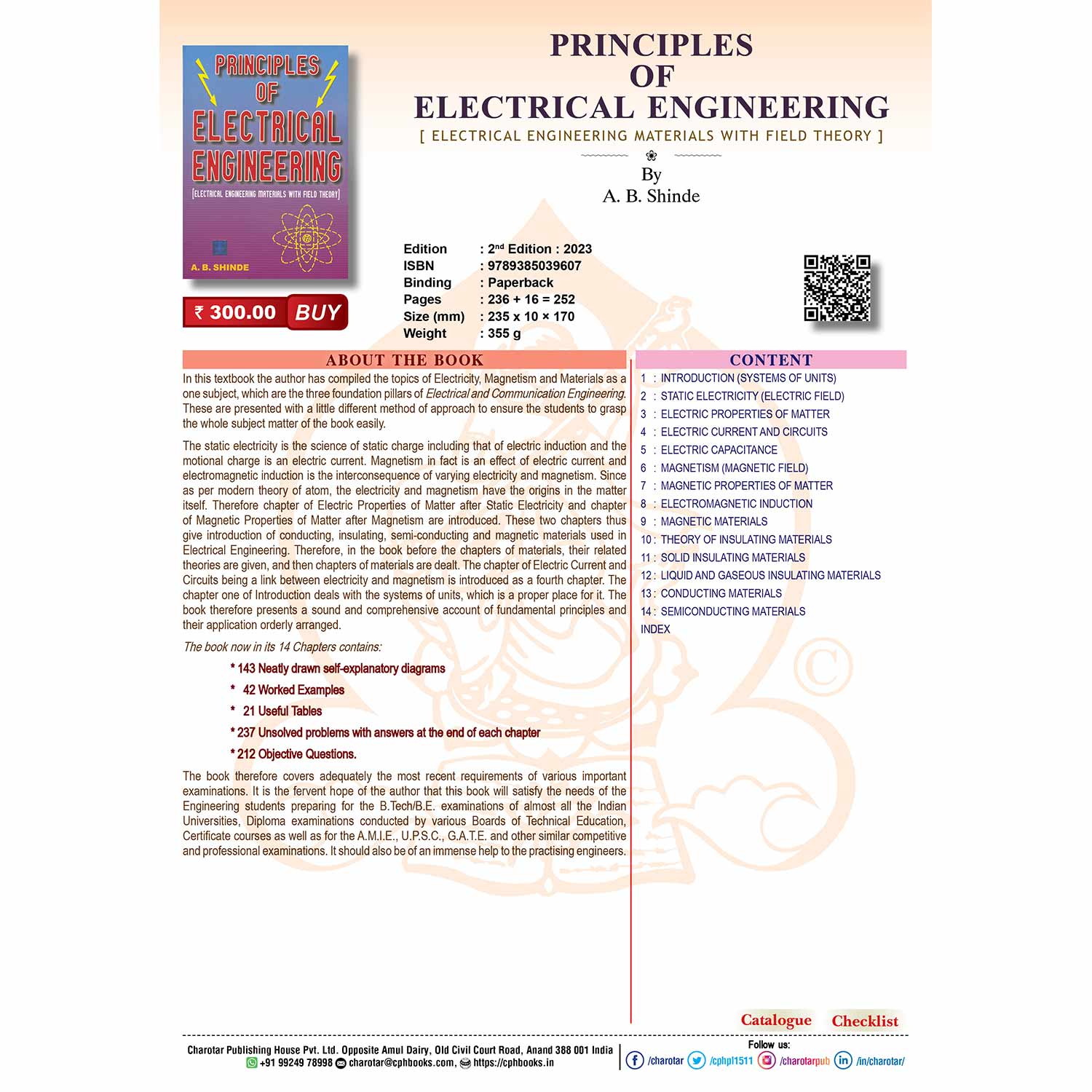
Content
1 : INTRODUCTION (SYSTEMS OF UNITS)
2 : STATIC ELECTRICITY (ELECTRIC FIELD)
3 : ELECTRIC PROPERTIES OF MATTER
4 : ELECTRIC CURRENT AND CIRCUITS
5 : ELECTRIC CAPACITANCE
6 : MAGNETISM (MAGNETIC FIELD)
7 : MAGNETIC PROPERTIES OF MATTER
8 : ELECTROMAGNETIC INDUCTION
9 : MAGNETIC MATERIALS
10 : THEORY OF INSULATING MATERIALS
11 : SOLID INSULATING MATERIALS
12 : LIQUID AND GASEOUS INSULATING MATERIALS
13 : CONDUCTING MATERIALS
14 : SEMICONDUCTING MATERIALS
index
Content Details
[vc_row][vc_column][vc_tta_tabs][vc_tta_section title=”Page 1″ tab_id=”1583922191426-e4af6cdf-5234″][vc_column_text]
Chapter 1 INTRODUCTION (SYSTEMS OF UNITS)
1-1 Introduction
1-2 Metric (cgs) system of units
1-3 Relation between electric and magnetic units
1-4 Practical system of units
1-5 Mks (giorgi) system of units
1-6 Relations with cgs units
1-7 Rationalization of poles
1-8 System international d’ units (SI)
Problems 1
Objectives 1
Chapter 2 STATIC ELECTRICITY (ELECTRIC FIELD)
2-1 Introduction
2-2 Electric charge
2-3 Coulomb’s law
2-4 Charging a body and charge density
2-5 Electric field
2-6 Electric flux
2-7 Electric flux density
2-8 Extension of coulomb’s law in electric media
2-9 Gauss’ law
2-10 Relation between D and e
2-11 Electric field due to a charged sphere
2-12 Electric potential
2-13 Potential at a point due to the number of charges
2-14 Maxwell’s potential coefficient method
2-15 Potential difference and potential gradient
2-16 Electric field and potential distribution of a charged sphere
2-17 Electric moment
2-18 Field at a point due to a dipole
2-19 Field at a point along the axis of a charged ring
2-20 Electric field around a charged thin wire
2-21 Electric field around a charged cylinder
2-22 Electric field between two charged cylinders
2-23 Field between two charged parallel plates
2-24 Poisson’s and laplace’s equations
2-25 Equipotential surfaces
2-26 Energy stored in an electric field
Problems 2
Objectives 2
Chapter 3 ELECTRIC PROPERTIES OF MATTER
3-1 Introduction
3-2 Classical theory of atom
3-3 Neils Bohr theory
3-4 Electronic structure of element
3-5 Electronic shells
3-6 Valence electrons
3-7 Structure of matter
3-8 Classification of electrical materials
3-9 Electric field distribution and potential barrier
3-10 Charging of insulating materials
3-11 Electric permittivity
3-12 Boundary condition at two anisotropic media
3-13 Polarization
Problems 3
Objectives 3
Chapter 4 ELECTRIC CURRENT AND CIRCUITS
4-1 Introduction
4-2 Conduction through metals, electric current
4-3 Average value of current
4-4 Quantity of electricity
4-5 Electric conduction and conductivity
4-6 Electrical resistance and resistivity
4-7 Effect of temperature on resistance
4-8 Electrical energy and power
4-9 Heating effect of electric current (Joule’s law)
4-10 Alternating current
4-11 Average values
4-12 Effective value and form factor
4-13 Kirchhoff’s laws
(1) Kirchhoff’s current law
(2) Kirchhoff’s voltage law
4-14 Resistors in series and in parallel
4-15 Measurement of electrical quantities
Problems 4
Objectives 4
Chapter 5 ELECTRIC CAPACITANCE
5-1 Introduction
5-2 Electric capacitance
5-3 Self-capacitance of an isolated charged sphere
5-4 Capacitance of a parallel plate capacitor (air cored)
5-5 Capacitance of dielectric capacitor
5-6 Energy stored in a charged capacitor
5-7 Capacitance of cylindrical capacitor
5-8 Capacitance of spherical capacitor
5-9 Capacitors in series and in parallel
5-10 Multiplate capacitors
5-11 Capacitance of single straight conductor parallel to earth
(method of electric images)
5-12 Capacitance of two parallel conductors
5-13 Capacitance of three symmetrically spaced conductors
Problems 5
Objectives 5
Chapter 6 MAGNETISM (MAGNETIC FIELD)
6-1 Introduction
6-2 Magnetic poles
6-3 Coulomb’s law
6-4 Magnetic field
6-5 Magnetic flux density
6-6 Extension of coulomb’s law in the magnetic media
6-7 Gauss’ law
6-8 Magnetic moment
6-9 Magnetic potential
6-10 Magnetic potential at a point due to a magnetic pole
6-11 Energy associated with the magnetic field
6-12 Magnetic effect of electric current
6-13 Direction of fields
6-14 Magnetic field of a straight conductor
6-15 Ampere’s circuital law
6-16 Magnetic field of current carrying conductor
6-17 Magnetomotive force
6-18 Field of a circular coil
6-19 Solenoid
Problems 6
Objectives 6
Chapter 7 MAGNETIC PROPERTIES OF MATTER
7-1 Introduction
7-2 Theory of magnetism
7-3 Barkhausen effect
7-4 Surface currents
7-5 Magnetic permeability
7-6 Magnetization
7-7 Magnetic hysteresis
7-8 Magnetization curves
[/vc_column_text][/vc_tta_section][vc_tta_section title=”Page 2″ tab_id=”1583922191451-6a31604b-52a9″][vc_column_text]
7-9 Magnetic circuit and law of magnetic flux
7-10 Series and parallel magnetic circuits
7-11 Electromagnet
Problems 7
Objectives 7
Chapter 8 ELECTROMAGNETIC INDUCTION
8-1 Introduction
8-2 Induced electromotive force (emf) and Lenz’s law
8-3 Dynamically induced emf
8-4 Self-induction
8-5 Energy of an inductor
8-6 Mutual induction
8-7 Inductors in series and in parallel
8-8 Inductance of two parallel conductors
8-9 Inductance of three symmetrically spaced conductors
8-10 Eddy currents
8-11 Force on a current carrying conductor
8-12 Force between two current carrying conductors
Problems 8
Objectives 8
Chapter 9 MAGNETIC MATERIALS
9-1 Introduction
9-2 Permanent (hard) magnetic materials
9-3 Low-loss (soft) magnetic materials
9-4 Nickel steels
9-5 Grain oriented sheet steel
9-6 Ferrites
Problems 9
Objectives 9
Chapter 10 THEORY OF INSULATING MATERIALS
10-1 Introduction
10-2 Effect of temperature and frequency on permittivity
10-3 Ferroelectric materials
10-4 Conduction in insulating materials
10-5 Dielectric loss
10-6 Breakdown in solid insulating materials
10-7 Breakdown in liquid and gaseous insulating materials
10-9 Standard electrode gap
Problems 10
Objectives 10
Chapter 11 SOLID INSULATING MATERIALS
11-1 Introduction
11-2 Fibrous materials
(1) Wood
(2) Pressboards
(3) papers
(4) Yarn cloths (fabrics)
(5) Cotton yarn
(6) Artificial fabrics
(7) Synthetic fabrics
(8) Varnished cloths
11-3 Asbestos
11-4 Mica and mica based products
11-5 Glass
11-6 Porcelain
11-7 Ceramics
(1) Radio porcelain
(2) Ultra porcelain
(3) High aluminium ceramic
(4) Lucalox
(5) Steatite ceramic
(6) High permittivity ceramics
(7) Rutile ceramic
(8) Calcium titanate ceramic
(9) Strontium titnate ceramic
(10) High temperature ceramics
(11) Cordierit ceramics
(12) Oxide free ceramics
11-8 Rubbers (elastomers)
(1) Natural rubber
(2) Rubber moulded products
(i) Silicon rubber
(ii) Syntheic rubber
(iii) Butadiene rubber (escapon)
(iv) Styrene butadiene rubber
(v) Butyl rubber
(vi) Chloroprene rubber
(3) Polyvinyle chloride (P.V.C.)
11-9 Moulded plastics
Properties to plastics
11-10 Laminated plastics
(1) P.V.C. sheets
(2) Pertinex
(3) Textolite
(i) Textopertinex
(ii) Laminated pertinex
(iii) Glass fabric laminate
(iv) Foil laminated pertinex
11-11 Adhesive tapes
Problems 11
Objectives 11
Chapter 12 LIQUID AND GASEOUS INSULATING MATERIALS
12-1 Introduction
12-2 Resins
(1) Natural Resins, Shellac
(2) Rosins
(3) Copals
(4) Synthetic Resins
(5) Polytetrafluro ethylenes (Polyolefins) resins
(6) Polyvinyle chloride
(7) Polymide resins
(8) Polyester resins
(9) Phenol formaldehyde resins
(10) Epoxy resins
(11) Silicon resins
12-3 Bitumens
Asphalts
12-4 Waxes
(1) Paraffin
(2) Ceresin
(3) Synthetic Paraffins
(4) Vaseline (petroleum jelly)
12-5 Potting compounds
12-6 Vegetable oils
(1) Castor Oil
(2) Linseed Oil
(3) Tung Oil
12-7 Insulation varnishes
(1) Adhesive Varnishes
(2) Bakelite varnishes
(3) Glyptal varnishes
(4) Oleoglyptal varnishes
[/vc_column_text][/vc_tta_section][vc_tta_section title=”Page 3″ tab_id=”1583922304520-6ce135d2-568e”][vc_column_text]
(5) Epoxy varnishes
(6) Impregnating varnishes
(7) Oil varnishes
(8) Coating Varnishes
(9) Bituminous varnishes
(10) Oleobitumious varnishes
(11) Silicon varnishes
(12) P.V.C. varnishes
(13) Cellulose resinous varnishes
(14) Coating Enamels
12-8 Transformer oil
Testing of transformer oil
Acidity of oil
Reprocessing of oil
Other uses of transformer
12-9 Synthetic liquid dielectrics
(1) Askarels/Sovol
(2) Silicon liquids
(3) Flurocarbon liquids
12-10 Gaseous insulating materials
(1) Dry air
(2) Nitrogen
(3) Hydrogen
(4) Sulphur hexafluoride (SF6
)
12-11 Classification of insulating materials
Problems 12
Objectives 12
Chapter 13 CONDUCTING MATERIALS
13-1 Introduction
13-2 Conductors
(1) Copper
(2) Aluminium
(3) Silver
(4) Mercury
(5) Bronze
(6) Brass
(7) Alderey
(8) Steel
(9) Carbon
13-3 Resistance materials
(1) Manganin
(2) German silver
(3) Constantan (eureka)
(4) Nichromes
(5) Fechral and chromel
(6) Platinum-iridium
13-4 Thermocouple materials
13-5 Thermal bimetallic materials
13-6 Refractory materials
(1) Carbon
(2) Tungsten
(3) Molybdenum
(4) Platinum
13-7 Contact materials
13-8 Fuse materials
(1) Tin
(2) Lead
(3) Tin-lead alloy
13-9 Soldering materials
(1) Solder
(2) Flux
13-10 Superconductors
Problems 13
Objectives 13
Chapter 14 SEMICONDUCTING MATERIALS
14-1 Introduction
14-2 Intrinsic and extrinsic semiconductors
14-3 Conduction in extrinsic semiconductors
14-4 Determination of types of conduction
14-5 Effect of impurity density on charge carriers
14-6 Effect of light (photon) radiation
14-7 Semiconductor elements
(1) Germanium
(2) Silicon
(3) Selenium
14-8 Compound semiconductors
(1) Silicon carbide
(2) Gallium arsenides
(3) Indium antimonide
(4) Sulphides
(5) Oxides
Problems 14
Objectives 14
Index
[/vc_column_text][/vc_tta_section][/vc_tta_tabs][/vc_column][/vc_row]
Only logged in customers who have purchased this product may leave a review.


Reviews
There are no reviews yet.