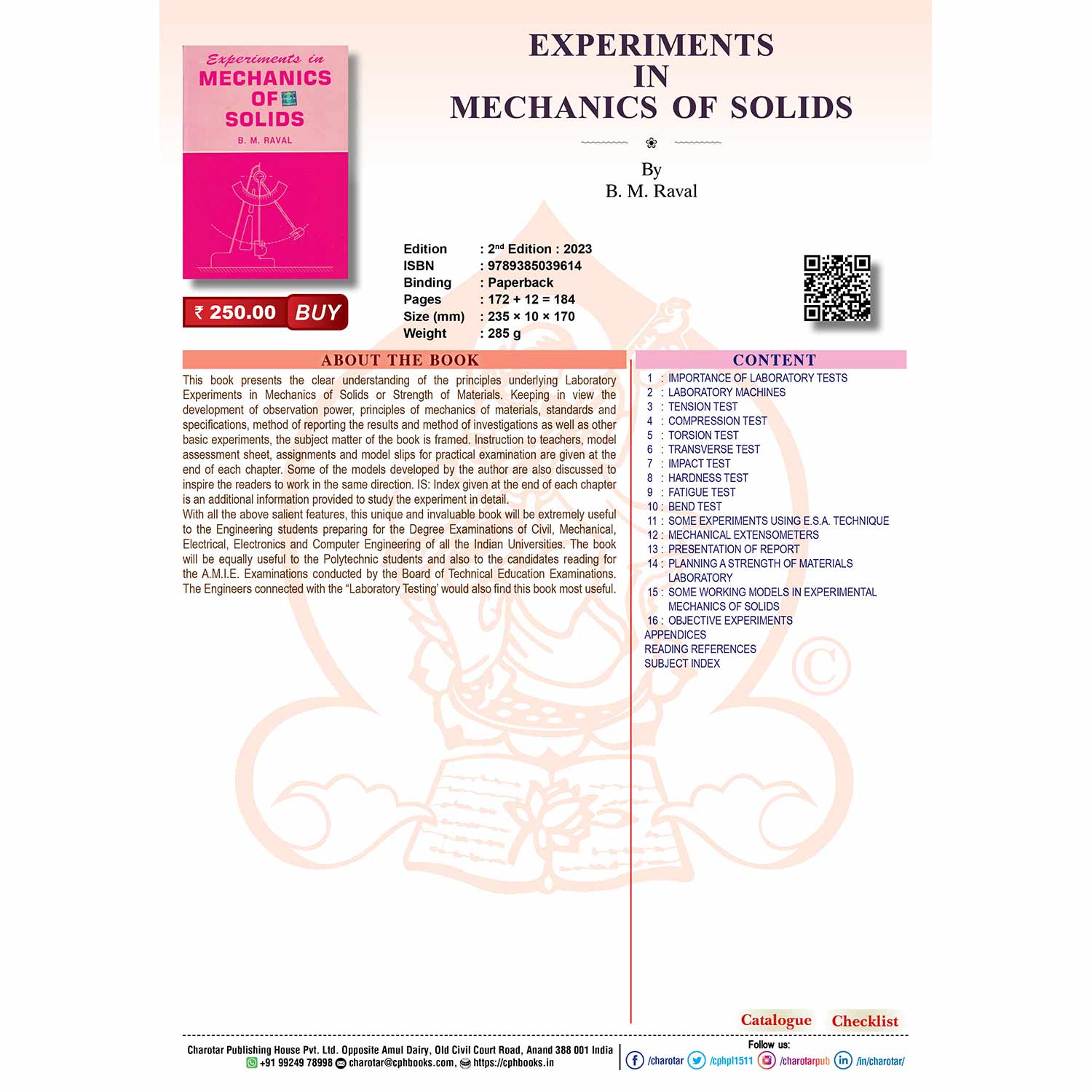
Content
1 : IMPORTANCE OF LABORATORY TESTS
2 : LABORATORY MACHINES
3 : TENSION TEST
4 : COMPRESSION TEST
5 : TORSION TEST
6 : TRANSVERSE TEST
7 : IMPACT TEST
8 : HARDNESS TEST
9 : FATIGUE TEST
10 : BEND TEST
11 : SOME EXPERIMENTS USING E.S.A. TECHNIQUE
12 : MECHANICAL EXTENSOMETERS
13 : PRESENTATION OF REPORT
14 : PLANNING A STRENGTH OF MATERIALS
LABORATORY
15 : Some WORKING MODELS IN EXPERIMENTAL
MECHANICS OF SOLIDS
16 : OBJECTIVE EXPERIMENTS
Appendices
READING REFERENCES
SUBJECT INDEX
Details Content
[vc_row][vc_column][vc_tta_tabs][vc_tta_section title=”Page 1″ tab_id=”1584093357691-36485d85-2392″][vc_column_text]
Chapter 1 IMPORTANCE OF LABORATORY TESTS
1-1 General
1-2 Importance of testing
1-3 Short explanation of mechanical properties of materials
1-4 Important factors
1-5 Types of tests
1-6 Test design
1-7 Specimen
1-8 Testing
1-9 Specification and standards
1-10 Testing machines
1-11 Classification of properties of engineering materials
1-12 Laboratory exercises
1-13 General laboratory testing
1-14 Purpose of different tests
1-15 Use of structural materials
1-16 Course of study
Chapter 2 LABORATORY MACHINES
2-1 Instruction
2-2 Single lever testing machines
2-3 Static testing machines
2-3-1 Universal testing machine
2-3-2 Torsion testing machine
2-4 Calibration of testing machines
2-5 Procedure for calibration of testing machine
2-6 Common instruments for dimension of a specimen measurement
Chapter 3 TENSION TEST
3-1 Tension test
3-2 Important terms in tension test
3-2-1 Gage length (Lo)
3-2-2 Extension or elongation (dL)
3-2-3 Stress (s)
3-2-4 Strain (Î)
3-2-5 Modulus or elasticity (E)
3-2-6 Yield stress (fy)
3-2-7 Permanent set
3-2-8 Tensile strength
3-2-9 Percentage elongation
3-2-10 Percentage reduction in area
3-3 Procedure for tension test
3-4 Reporting of results
3-5 Discussion
3-6 Observations
3-7 Calculation
3-8 True stress and true strain
3-9 For teachers
3-10 Model assessment sheet
3-11 Assignments to determine mechanical properties in tension test
3-12 Assignments for practice
3-13 Model assignment slips for practical examination
Chapter 4 COMPRESSION TEST
4-1 Compression test
4-2 Specimen
4-3 Test procedure
4-4 Reporting of results
4-5 Discussion
4-6 For teachers
4-7 Model assessment sheet
4-8 Assignments to determine mechanical properties in compression test
4-9 Assignment for practice
4-10 Model assignment slips for practical examination
Chapter 5 TORSION TEST
5-1 Torsion test
5-2 Specimen
5-3 Torsion testing machine
5-4 Test procedure
5-5 For teachers
5-6 Model assessment sheet
5-7 Assignment to determine mechanical properties in torsion test
5-8 Assignment for practice
5-9 Model assignment slips for practical examination
Chapter 6 TRANSVERSE TEST
6-1 Transverse test
6-2 Specimen
6-3 Supports and loading
6-4 Important point
6-5 Test procedure
6-6 Observation
6-7 For teachers
6-8 Model assessment sheet
6-9 Assignments to determine mechanical properties in transverse
test
6-10 Assignment for practice
6-11 Model assignment slips for practical examination
Chapter 7 IMPACT TEST
7-1 Impact test
7-2 Principle of impact test
7-3 Types of impact test and specimen
7-4 Procedure for test
7-5 For teachers
7-6 Model assessment sheet
7-7 Assignments to determine mechanical properties in impact test
7-8 Assignment for practice
7-9 Model assignment slips for practical examination
Chapter 8 HARDNESS TEST
8-1 Hardness test
8-2 Types of test
8-3 Brinell hardness test
8-3-1 Specimen for test
8-3-2 Principle of test
8-3-3 Procedure for test
8-4 Precautions
8-5 Rockwell test
8-5-1 Procedure for rockwell test
8-6 Observation (Report)
8-7 For teachers
8-8 Model assessment sheet
8-9 Model assignment slips for practical examination
Chapter 9 FATIGUE TEST
9-1 Fatigue test
9-2 Types of stress employed in fatigue test
9-3 Reverse bending type fatigue test
9-4 Procedure
9-5 For teachers
9-6 Model assessment sheet
9-7 Assignment on fatigue test
9-8 Assignment for practice
[/vc_column_text][/vc_tta_section][vc_tta_section title=”Page 2″ tab_id=”1584093357714-49033697-3bac”][vc_column_text]
Chapter 10 BEND TEST
10-1 Bend test
10-2 Specimen preparation
10-3 Method of test
10-4 Machine used for bend test
10-5 For teachers
10-6 Model assessment sheet
Chapter 11 SOME EXPERIMENTS USING E.S.A. TECHNIQUE
11-1 Introduction and experiments
11-2 For teachers
Chapter 12 MECHANICAL EXTENSOMETERS
12-1 Introduction
12-2 Types of extensometers
12-3 For teachers
Chapter 13 PRESENTATION OF REPORT
13-1 Presentation of report
13-2 Front page or cover page
13-3 Other pages
13-4 Special coverage
13-5 Final submission
13-6 For teachers
Chapter 14 PLANNING A STRENGTH
OF MATERIALS LABORATORY
14-1 Planning of laboratory
14-2 Equipments required for the laboratory
14-3 Furniture and other requirements
Chapter 15 WORKING MODELS IN EXPERIMENTAL
MECHANICS OF SOLIDS
15-1 Introduction
15-2 Model for column buckling concept
15-3 Model for concept of stability
15-4 Model for concept of elongation
15-5 Bracket connection
15-6 Model for influence diagram for bending moment
15-7 Model for strain energy concept due to suddenly applied load
15-8 Working model: springs in parallel
15-9 Torsion test
Chapter 16 OBJECTIVE EXPERIMENTS
16-1 Introduction
16-2 Tension test
16-3 Compression test
16-4 Torsion test
16-5 Impact test
16-6 Transverse test
16-7 Hardness test
16-8 Test on compound spring
16-9 Fatigue test
16-10 General questions
Appendices:
A Some useful Indian Standards for physical tests
B Elastic constant, Rankine’s constant for different Materials
C Typical properties of material used in engineering
D Formula useful in material testing
E Loading arrangement on beam for transverse test
F Some useful information about SI unit
G Symbolic use of some useful Greek alphabet
SUBJECT INDEX
[/vc_column_text][/vc_tta_section][/vc_tta_tabs][/vc_column][/vc_row]
Only logged in customers who have purchased this product may leave a review.










Reviews
There are no reviews yet.