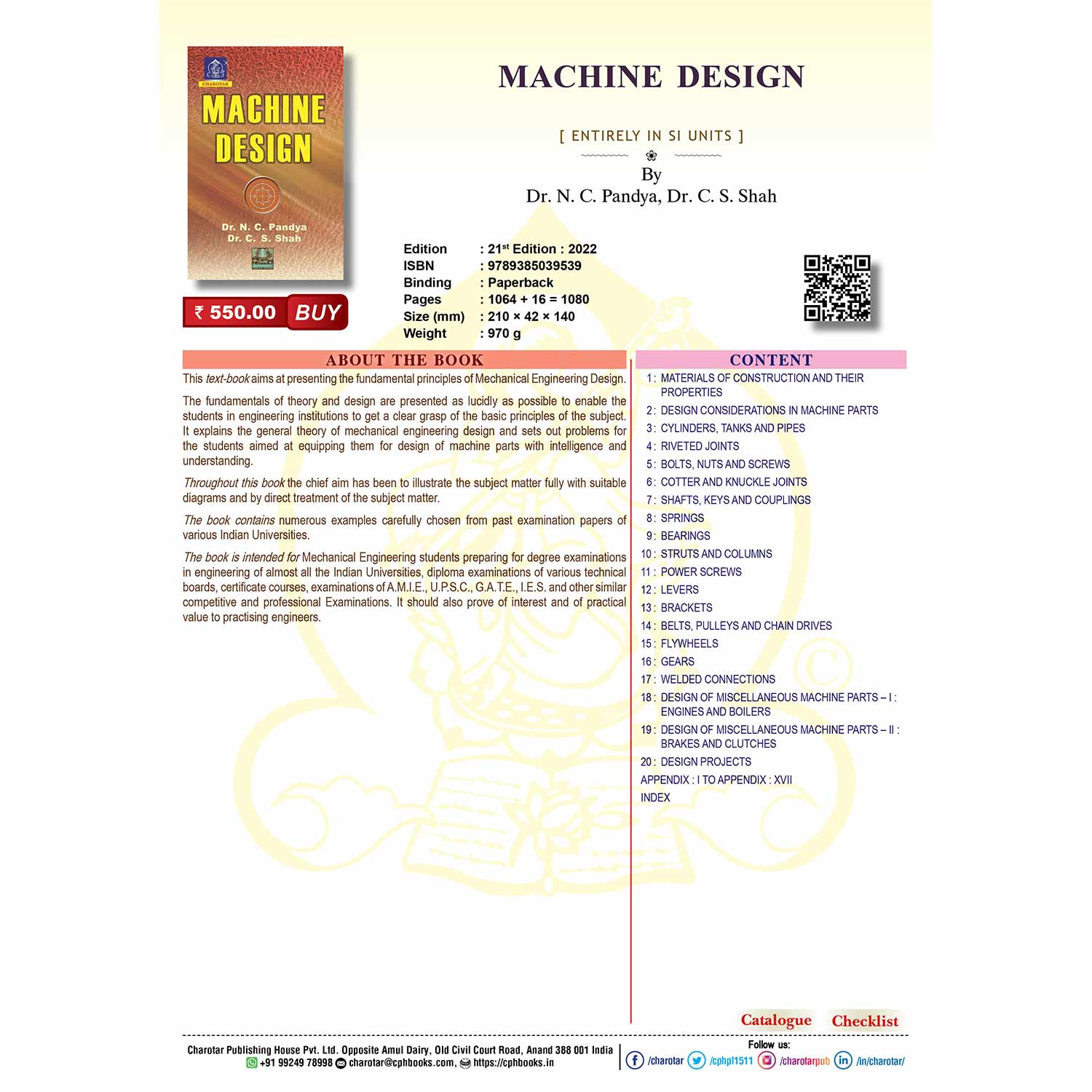
Content
1 : MATERIALS OF CONSTRUCTION AND THEIR
PROPERTIES
2 : DESIGN Considerations IN MACHINE PARTS
3 : CYLINDERS, TANKS AND PIPES
4 : RIVETED JOINTS
5 : BOLTS, NUTS AND SCREWS
6 : COTTER AND KNUCKLE JOINTS
7 : SHAFTS, KEYS AND COUPLINGS
8 : SPRINGS
9 : BEARINGS
10 : STRUTS AND COLUMNS
11 : POWER SCREWS
12 : LEVERS
13 : BRACKETS
14 : BELTS, PULLEYS AND CHAIN DRIVES
15 : FLYWHEELS
16 : GEARS
17 : WELDED CONNECTIONS
18 : DESIGN OF MISCELLANEOUS MACHINE PARTS – I :
ENGINES AND BOILERS
19 : DESIGN OF MISCELLANEOUS MACHINE PARTS – II :
BRAKES AND CLUTCHES
20 : DESIGN PROJECTS
Appendix : I to APPENDIX : XVII
INDEX
Detailed Content
[vc_row][vc_column][vc_tta_tabs][vc_tta_section title=”Page 1″ tab_id=”1583906076549-32d3877a-7b49″][vc_column_text]
Chapter 1 MATERIALS OF CONSTRUCTION AND THEIR
PROPERTIES 1-1. Introduction 1-2. Choice of material 1-3. Materials of construction 1-4. Structure of materials 1-5. Mechanical properties of materials of construction 1-6. Determination of mechanical properties 1-7. Fabrication characteristics and processes of fabrication 1-8. Ferrous metals — Cast iron, wrought iron and steel 1-9. Non-ferrous metals and alloys 1-10. Available sizes 1-11. Accuracy 1-12 Finishing processes 1-13. Non-metallic materials 1-14. Plastics 1-15. Composite materials 1-16. Improvements in properties of materials Examples I
Chapter 2 DESIGN CONSIDERATIONS IN MACHINE PARTS
2-1. Loads 2-2. Stress 2-3. Strain 2-4. Stress-Strain diagram — Modulus of elasticity 2-5. Poisson’s ratio 2-6. Modulus of rigidity 2-7. Bulk modulus 2-8. Basic requirements of machine elements 2-9. Factor of safety: Selection of allowable stresses 2-10. Procedure for designing a machine element 2-11. Tensile stress 2-12. Compressive stress 2-13. Shearing stress 2-14. Bearing pressure intensity 2-15. Bending (Flexure) 2-6. Shear stresses in a beam 2-17. Torsion 2-18. Eccentric loading 2-19. Combined stresses: Bending combined with direct load 2-20. Offset connecting links and C shaped frames 2-21. Shear stresses combined with tensile and compressive stresses 2-22. Theories of elastic failure 2-23. Designing for impact loads 2-24. Design of members subjected to impact torsion 2-25. Stress concentration 2-26. Notch sensitivity 2-27. Effect of repeated application of a load 2-28. Fluctuating stress for ductile materials 2-29. Cummulative damage in fatigue: (Miner’s equation) 2-30. Fatigue life determined by short-term testing 2-31. Light weight and minimum dimensions 2-32. Elastic matching 2-33. Temperature stresses Examples II
Chapter 3 CYLINDERS, TANKS AND PIPES
3-1. Introduction 3-2. Types of vessels 3-3. Design of thin cylinders 3-4. Design of a thin spherical shell 3-5. Cylindrical shell with hemispherical ends 3-6. General theory of membrane stresses in vessels under internal pressure
3-7. Design of pipes 3-8. Design of thick cylinders 3-9. Design equation for thick cylinders Examples III
Chapter 4 RIVETED JOINTS
4-1. Introduction 4-2. Rivets 4-3. Rivet heads 4-4. Types of riveted joints 4-5. Caulking and fullering 4-6. Design of a riveted joint for boiler construction 4-7. Efficiency of a riveted joint 4-8. Joints for storage tanks 4-9. Lozenge joint 4-10. Eccentric loads on riveted connections 4-11. Rules in designing riveted joints 4-12. Advantages of welding over riveting Examples IV
Chapter 5 BOLTS, NUTS AND SCREWS
5-1. Introduction 5-2. Definitions 5-3. Forms of screw threads 5-4. Advantages of square threads over V threads 5-5. Screw fastenings 5-6. Locking devices for nuts 5-7. Washers 5-8. Eye bolt 5-9. Efficiency of threads 5-10. Stresses in screw fastenings 5-11. Initial stresses 5-12. Stresses due to external forces 5-13. Stresses due to combined load 5-14. Bolts of uniform strength 5-15. Screwed boiler stays 5-16. Bolts subjected to shear 5-17. Bolts under eccentric loading 5-18. Design of a nut 5-19. Power transmitting capacity of set screws Examples V
Chapter 6 COTTER AND KNUCKLE JOINTS
(A) Design of cpttered joints 6-1. Introduction 6-2. Design of cottered joints 6-3. Gib and cotter 6-4. Connection of a piston rod to a crosshead 6-5. Cotter foundation bolts (B) Design of a knuckle joint 6-6. Introduction 6-7. Joint of suspension links 6-8. Design of a coupler or a turnbuckle Examples VI
Chapter 7 SHAFTS, KEYS AND COUPLINGS
7-1. Introduction 7-2. Materials and design stresses 7-3. Design of axles 7-4. Design of shafts on the basis of strength 7-5. Design of shafts on the basis of rigidity 7-6. Design of hollow and non-circular shafts 7-7. Form of keys 7-8. Keys 7-9. Design of sunk keys 7-10. Effect of keyways in sunk keys
[/vc_column_text][/vc_tta_section][vc_tta_section title=”Page 2″ tab_id=”1583906076582-88dece98-c364″][vc_column_text]
7-11. Taper pins 7-12. Feather keys and splined shafts 7-13. Force and shrink fits (Driving fits on solid shafts) 7-14. Couplings: Introduction 7-15. Sleeve couplings or muff couplings 7-16. Clamp or compression couplings 7-17. Flange-couplings 7-18. Marine type of flange couplings 7-19. Flexible couplings 7-20. Bushed pin type of flexible couplings 7-21. Bibby type of flexible coupling 7-22. Leather pad type flexible coupling 7-23. Oldham’s coupling 7-24. Universal coupling 7-25. Safety couplings 7-26. Flexible shafts Examples VII
Chapter 8 SPRINGS
8-1. Introduction 8-2. Close coiled helical springs subjected to axial loading — Circular wire 8-3. Optimum design of helical springs 8-4. Helical springs of non-circular wires 8-5. Concentric helical springs 8-6. General considerations in design of compression and extension springs 8-7. Torsion helical springs 8-8. Spiral springs (Power springs) 8-9. Leaf springs 8-10. Belleville springs 8-11. Energy-storage capacity Examples VIII
Chapter 9 BEARINGS
9-1. Introduction 9-2. Bearing area 9-3. Sliding bearings: Solid journal bearings 9-4. Divided journal bearing: Plummer block 9-5. Hydrodynamic theory of lubrication 9-6. Oil grooving 9-7. Heating of bearings 9-8. Design procedure for hydrodynamic journal bearings 9-9. Bearing materials 9-10. Design of bearing caps and bolts 9-11. Foot step or pivot bearings 9-12. Collar bearings 9-13. Anti-friction bearings 9-14. Radial ball bearings 9-15. Roller bearings 9-16. Selection of ball and roller bearings 9-17. Bearing load 9-18. Equivalent bearing load 9-19. Carrying capacity and life 9-20. Relationship between load and life 9-21. Requisite bearing life for different types of machines 9-22. Life of Timken bearings 9-23. Influence of high temperatures on load carrying capacity 9-24. Permissible misalignment 9-25. Friction in rolling bearings 9-26. Comparison of sleeve and rolling bearings Examples X
Chapter 10 STRUTS AND COLUMNS
10-1. Introduction 10-2. Euler’s formula 10-3. End fixity coefficients 10-4. Radius of gyration and plane of buckling 10-5. Rankine’s formula 10-6. Tetmajer’s formula 10-7. Johnson formula 10-8. Design of push rods 10-9. Eccentrically loaded columns Examples X
Chapter 11 POWER SCREWS
11-1. Introduction 11-2. Forms of threads 11-3. Force analysis 11-4. Design of a screw 11-5. Design of a nut 11-6. Practical design of simple lifting machines (screw jack) 11-7. Compound screw 11-8. Differential screw 11-9. Ball screws Examples XI
Chapter 12 LEVERS
12-1. Introduction 12-2. General procedure for design of levers 12-3. Hand lever 12-4. Foot lever 12-5. Cranked lever 12-6. Lever of a lever loaded safety valve 12-7. Rocker arm for Diesel engines (Straight arm) 12-8. Angular levers 12-9. Design of overhung cranks 12-10. Design of a crank pin (overhung crank) 12-11. Miscellaneous examples Examples XII
Chapter 13 BRACKETS
13-1. Brackets 13-2. Hangers 13-3. Wall boxes 13-4. Design considerations Examples XIII
Chapter 14 BELTS, PULLEYS AND CHAIN DRIVES
14-1. Introduction 14-2. Materials for belts 14-3. Design of belts 14-4. Design procedure for flat belts 14-5. V-belt drives 14-6. Design of V-flat drives 14-7. Pulleys: Materials and types 14-8. Cast iron pulleys 14-9. Design of cast iron pulleys 14-10. Steel pulleys 14-11. Wooden pulleys 14-12. Fast and loose pulleys 14-13. Speed cones 14-14. Short centre drive — Gravity idlers 14-15. Special tension adjusting belt drives 14-16. Chain drives (Introduction) 14-17. Roller chains 14-18. Design of chain drives Examples XIV
[/vc_column_text][/vc_tta_section][vc_tta_section title=”Page 3″ tab_id=”1583906102765-e0d51db9-c762″][vc_column_text]
Chapter 15 FLYWHEELS
15-1. Introduction 15-2. Determination of mass of a flywheel for a given coefficient of fluctuation of speed 15-3. Flywheel for punches and shears 15-4. Engine flywheels 15-5. Flywheel for electric generators 15-6. Stresses in rim of flywheels 15-7. Design of a hub 15-8. Arms of the flywheel Examples XV
Chapter 16 GEARS
16-1. Introduction (A) Design of spur gears 16-2. General characteristics 16-3. Spur gear terminology 16-4. Gear tooth forms 16-5. Accuracy of gears 16-6. Materials 16-7. Allowable stresses 16-8. Design considerations 16-9. Strength of gear teeth — Lewis equation 16-10. Dynamic tooth load 16-11. Design for wear 16-12. Gear wheel proportions 16-13. Internal gears 16-14. Racks (B) Design of helical gears 16-15. Introduction 16-16. Proportions for helical gears 16-17. Design of helical gear teeth 16-18. Herringbone gears 16-19. Rating of machine cut spur and helical gears (C) Design of bevel gears 16-20. Introduction 16-21. Definitions 16-22. Strength of bevel gear teeth 16-23. Constructional details 16-24. Bearing loads (D) Design of worm gears 16-24. Introduction 16-26. Worm gear nomenclature 16-27. Strength of worm gear teeth 16-28. Bearing loads on the shafts Examples XVI
Chapter 17 WELDED CONNECTIONS
17-1. Introduction 17-2. Welding processes 17-3. Types of welded joints 17-4. Working stresses in welds 17-5. Strength of welds 17-6. Special cases of fillet welds 17-7. Eccentric loads on welded connections 17-8. Design procedure recommended by American Welding Society 17-9. Fillet welds under varying loads Examples XVII
Chapter 18 DESIGN OF MISCELLANEOUS MACHINE
PARTS–I ENGINES AND BOILERS 18-1. Design of flat plates 18-2. Design of a piston for I.C. Engines 18-3. Design of crossheads 18-4. Design of connecting rods 18-5. Design of crankshafts 18-6. Design of a spring-loaded Hartnell governor 18-7. Design of an eccentric 18-8. Compensating ring for a manhole 18-9. Design of safety valves for boilers 18-10. Design of a screw down steam stop valve 18-11. Design of cams (I.C. Engines) 18-12. Design of a valve gear for I.C. Engines Examples XVIII
Chapter 19 DESIGN OF MISCELLANEOUS MACHINE
PARTS–II BRAKES AND CLUTCHES (A) Hoisting equipments 19-1. Introduction 19-2. Design of hoisting chains and drums 19-3. Design of a hoisting rope 19-4. Design of wire ropes 19-5. Stresses in curved beams 19-6. Design of a crane hook (B) Brakes 19-7. Introduction 19-8. Types of brakes 19-9. Design procedure for block brakes 19-10. Band brakes: Introduction 19-11. Design procedure for band brakes (C) Clutches 19-12. Introduction 19-13. Design procedure for friction clutches Examples XIX
Chapter 20 DESIGN PROJECTS
20-1. Introduction APPENDICES I to XVII APPENDIX I : International system of units (SI System) APPENDIX II : Sizes of pulleys for flat and V-belts APPENDIX III : Width of flat cast iron and mild steel pulleys APPENDIX VII : Basic thicknesses of sheet and diameters of wire in millimetres APPENDIX V : Properties of Ferrous Materials APPENDIX VI : Properties of Plastics APPENDIX VII : List of Indian Standards: “Testing of Materials” APPENDIX VIII : Indian Standards referred in the text APPENDIX IX : Preferred Numbers (Rounded values) APPENDIX X : (a) Metric coarse threads (b) Metric Fine threads APPENDIX XI : Common sizes of transmission shafts APPENDIX XII : Deflection formulas for machine parts APPENDIX XIII : Properties of geometrical Sections APPENDIX XIV : Imperial or Legal Standard Wire Gauge APPENDIX XV : Load carrying capacity of V-belts APPENDIX XVI : Service factors for belt drives APPENDIX XVII: Worm data
Index
Only logged in customers who have purchased this product may leave a review.










Reviews
There are no reviews yet.